The Streetwear Tracksuit Renaissance: Why Coordinated Sets Dominate 2026
- Share
- publisher
- Vainnx Editorial Team
- Issue Time
- Aug 17,2026
Summary
The streetwear tracksuit is back and dominating 2026. This guide covers why coordinated sets are winning, the fabrics and construction that matter, batch color matching in manufacturing, pricing strategy, and how Vainnx produces custom heavyweight fleece, French terry, velour, and embellished sets.
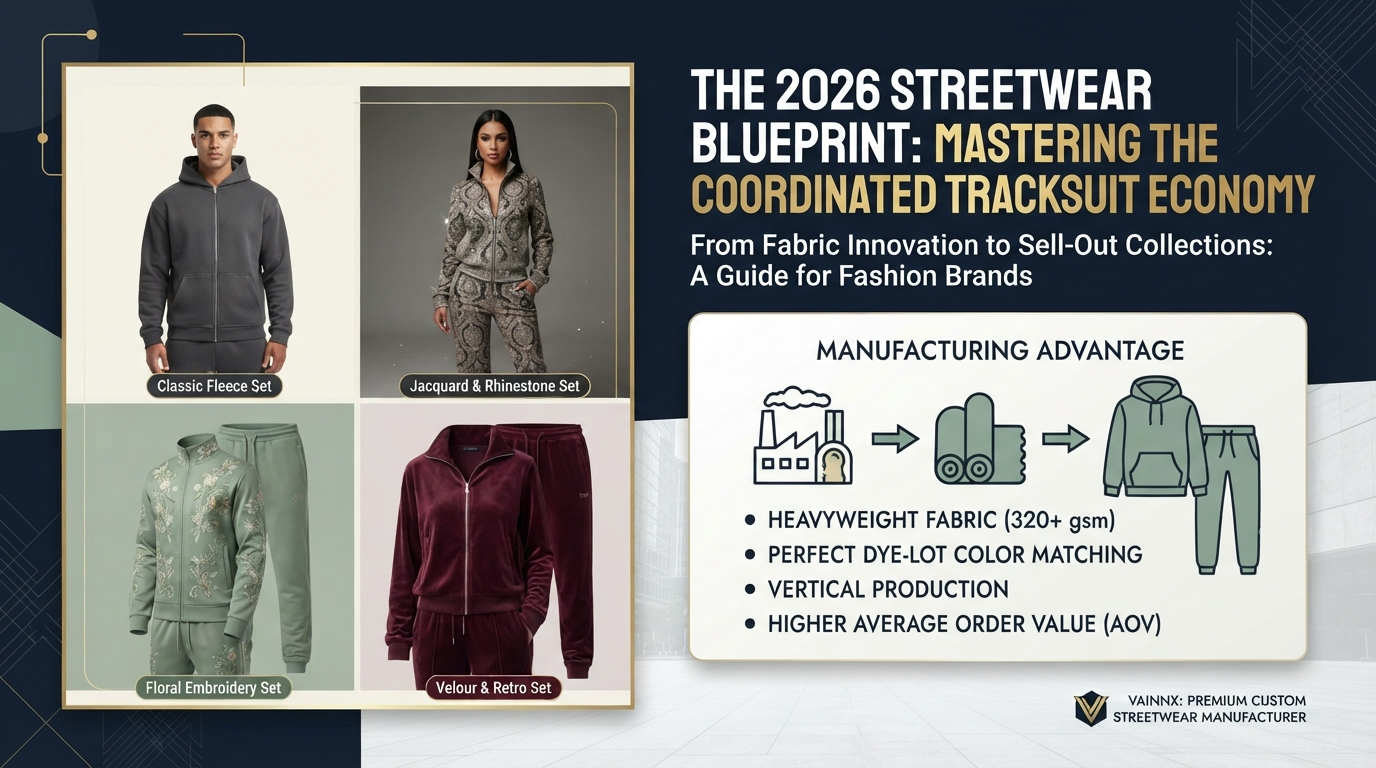
For two decades, the tracksuit carried quiet cultural baggage. It was the uniform of early-morning errands, lazy Sundays, and gym bags — never the centerpiece of a fashion collection. Then, almost overnight, the coordinated set became the most copied silhouette in streetwear. If your brand does not have a matching top-and-bottom set in its next drop, you are already behind the curve. This guide breaks down why the streetwear tracksuit is dominating 2026, what is driving the coordinated-set economy, the fabrics and construction that matter, and how a custom manufacturer like Vainnx — a premium B2B custom streetwear manufacturer based in China serving emerging and established fashion brands worldwide — turns a two-piece idea into a sell-out collection. What started as a comfort-driven rebound after 2020 has hardened into a structural shift. Search interest in terms like "matching set," "coordinated tracksuit," and "streetwear sweatsuit" has climbed steadily since 2023, and by early 2026 the category has moved out of athleisure and into the core of streetwear buying behavior. Brands that once sold a hoodie as a standalone piece now report that the hoodie-and-jogger pair drives the majority of cart value. The data behind the trend points one direction: consumers are buying complete looks, not isolated garments. Industry trackers note that coordinated sets now account for a meaningful share of new streetwear drops, and the average order value on a two-piece set routinely outperforms the sum of its parts sold separately. For a B2B buyer, that is the single most important number in this article. Why this matters for your production plan A coordinated set is not two SKUs bundled together — it is one product story, one fabric story, and one margin story. Brands that plan sets as a single manufacturing unit unlock better fabric pricing, tighter color consistency, and a higher perceived value per sale. The tracksuit's rise is not a single cause but a stack of cultural currents colliding at once. Understanding them is what separates brands that ride the trend from brands that chase it a season late. The luxury establishment spent years legitimizing the matching set. High-end houses and elevated basics labels turned the hoodie-and-jogger uniform into a premium product with price tags to match. That legitimacy trickled down fast: consumers now read a heavyweight coordinated set as intentional dressing, not as "giving up." Remote and hybrid work rewired how millions of people dress. The comfort-first wardrobe did not vanish when offices reopened; it got refined. The tracksuit became the bridge garment — polished enough for a video call from the chest up, comfortable enough for the rest of the day. Comfort is no longer a compromise. It is a purchasing criterion ranked alongside fit and brand identity. Consumers increasingly refuse garments that look good but feel punishing, which is precisely why heavyweight, soft-hand fabrics have become the streetwear benchmark rather than the budget option. The modern tracksuit is not a single silhouette. It spans a wide design spectrum, and the variation is where brands find their point of difference. The entry point. Clean lines, minimal branding, tonal drawcords. A dependable volume driver that anchors most collections. Embellished coordinated sets are the premium tier. Crystal placement and woven jacquard patterns turn a basic two-piece into a statement garment. All-over or chest embroidery adds texture and a couture edge, especially in demand for elevated street-luxe drops. The Y2K revival pushed velour back into rotation. Soft sheen, vintage colorways, and a nostalgic silhouette that photographs well. The takeaway for a brand: choose the variation that matches your identity, but always build the set around one hero fabric so the top and bottom read as one piece — not two garments that happen to share a colorway. Fabric is where a tracksuit wins or loses its premium feel. The difference between a set that sells for $40 and one that justifies $140 is almost always in the grams. Heavyweight fleece has become the default for premium streetwear because it delivers durability, drape, and a perceived-quality signal that thin fabric simply cannot match. The loop-back structure of French terry offers a lighter alternative without sacrificing softness, while velour carries the nostalgia that keeps the trend cycle spinning. Fabric selection is a margin decision, not just a design decision Heavier fabric costs more per unit and adds shipping weight, but it supports a higher retail price and stronger repeat purchase. For most emerging brands, a 320–380 gsm fleece set is the sweet spot between perceived luxury and landed cost. Producing a coordinated set is not the same as producing two separate garments. The manufacturing challenges are real, and they are where inexperienced suppliers fall down. The top and bottom of a set are often cut and sewn in different production runs or even different dye lots. If the fabric is not sourced and dyed together, the hoodie and joggers can arrive with a visible shade mismatch that ruins the "set" effect. Reliable manufacturers control this by reserving the same dye lot for both pieces. Because a set shares fabric, trims, drawcords, and often the same logo treatment, it consolidates procurement. Shared trims reduce per-unit cost, simplify QC, and let a factory run both pieces on overlapping lines — which shortens lead time compared with producing two unrelated garments. The economics of the tracksuit trend are simple and favorable. A coordinated set raises the average order value because the customer is committing to a complete look in a single decision. When a hoodie sells for $60 and joggers for $50, the paired set at $98 feels like a bargain while still delivering a stronger margin than either piece alone. Sets also reduce the mental friction of buying. A customer who loves the hoodie but hesitates over what to wear it with has just had that decision made for them. That is why coordinated drops consistently outperform mixed SKU drops on conversion, and why the trend is compounding rather than cooling. Pricing lever for emerging brands Position the set as the hero product at 2.5–3.5x landed cost, then offer individual pieces at a slight premium. The set becomes the obvious "best value," which steers customers toward the higher-ticket bundle. Vainnx manufactures coordinated tracksuits across the full design spectrum — from clean heavyweight fleece sets to jacquard and rhinestone-embellished pieces — with an in-house capability that covers fabric sourcing, cutting, sewing, embellishment, and finishing under one roof. That vertical control is exactly what a coordinated set requires, because it keeps both pieces on the same fabric lot and under the same quality checkpoint. For brands, the practical advantages translate directly into fewer headaches: flexible minimum order quantities for emerging labels, batch color consistency across top and bottom, and a production line that already runs heavyweight fleece, French terry, velour, and embroidered variations daily. Browse the production capabilities to see how a set moves from tech pack to finished goods. A coordinated set is a marketer's dream because it photographs as a complete story. The full-look image does the styling work for the customer, which makes it the highest-performing asset in your feed, your lookbook, and your product page. The brands winning this trend are the ones that treat the set as the product — not the hoodie with a matching option. That positioning shift, combined with the right fabric and a manufacturing partner that controls color consistency, is the difference between a drop that lingers and a drop that sells through. What is the best fabric for a streetwear tracksuit in 2026? Heavyweight fleece at 320–420 gsm is the current benchmark for premium streetwear sets. It delivers structure, durability, and a soft hand that reads as high quality. French terry is the lighter alternative for year-round wear, while velour suits retro and luxury-leaning drops. Why do coordinated sets sell better than individual pieces? Sets raise average order value by selling a complete look in a single decision and remove the styling friction that stops customers from buying individual pieces. The full-look presentation also performs better in marketing channels. How do I guarantee the hoodie and joggers match in color? Work with a manufacturer that reserves the same dye lot for both pieces and produces them under one roof. This is the most reliable way to avoid the shade mismatch that plagues sets produced across separate runs. What is a realistic MOQ for a custom tracksuit set? Minimum order quantities vary by fabric and embellishment, but many emerging brands start with flexible low-MOQ trial orders before scaling. Vainnx supports emerging labels with flexible minimums designed for first drops. Contact the team to discuss your specific set. The tracksuit renaissance is not a passing throwback. It is the convergence of the comfort economy, luxury athleisure, and the Y2K revival into a single, durable product category that raises average order value and simplifies production. Brands that build coordinated sets around heavyweight fabric, controlled color matching, and a full-look marketing strategy are positioned to capture the trend while it compounds. For a manufacturing partner that treats the set as one product — not two SKUs — send an inquiry to Vainnx and start with a conversation about fabric, minimums, and your next drop.
The Tracksuit Is Back — and This Time It Is Not Leaving
Why Coordinated Sets Suddenly Feel Unavoidable
Athleisure Grew Up and Crossed Into Luxury
The Work-From-Home Legacy Never Fully Faded
The Comfort Economy Is Now the Default
Design Variations: From Classic Fleece to Crystal Jacquard
Classic Fleece Set
Jacquard & Rhinestone Set
Floral Embroidery Set
Velour & Retro Set
Fabric Matters: Heavyweight Fleece, French Terry, and Velour
Fabric Typical Weight Hand Feel Best Use Heavyweight Fleece 320–420 gsm Dense, structured, premium drape Hoodie + jogger hero sets French Terry 280–340 gsm Loop-back, breathable, soft Year-round and transitional sets Velour 240–320 gsm Plush sheen, retro texture Y2K and luxury-leaning drops Cotton Jersey 200–280 gsm Light, smooth, fluid Summer and lounge-oriented sets Manufacturing Coordinated Sets: Color Matching and Set Efficiency
Batch Color Matching Is the Hidden Risk
Set Production Is More Efficient Than You Think
What to Ask Your Manufacturer
Pricing Strategy: Why Sets Command a Higher AOV
How Vainnx Produces Tracksuits
Marketing the Complete Look
Frequently Asked Questions
Conclusion: The Coordinated Set Is the Smartest Bet in 2026 Streetwear