OEM vs ODM vs Private Label Explained: Complete Manufacturing Guide
- Share
- publisher
- Vainnx Editorial Team
- Issue Time
- Jul 31,2026
Summary
A comprehensive guide explaining OEM, ODM, and Private Label manufacturing models for streetwear and fashion brands. Compare design ownership, customization depth, costs, timelines, MOQs, and learn which model best fits your brand stage. Vainnx supports all three.
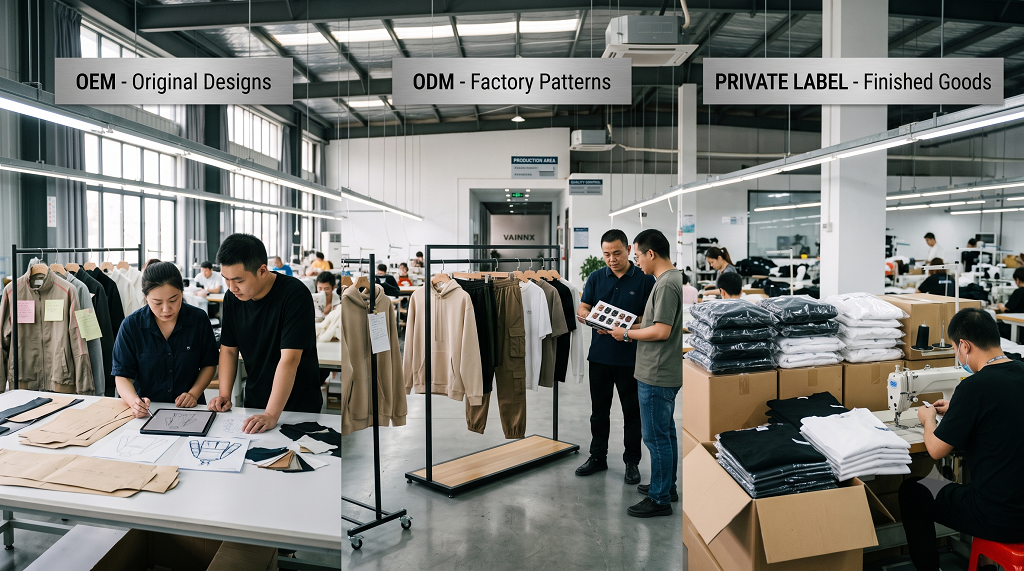
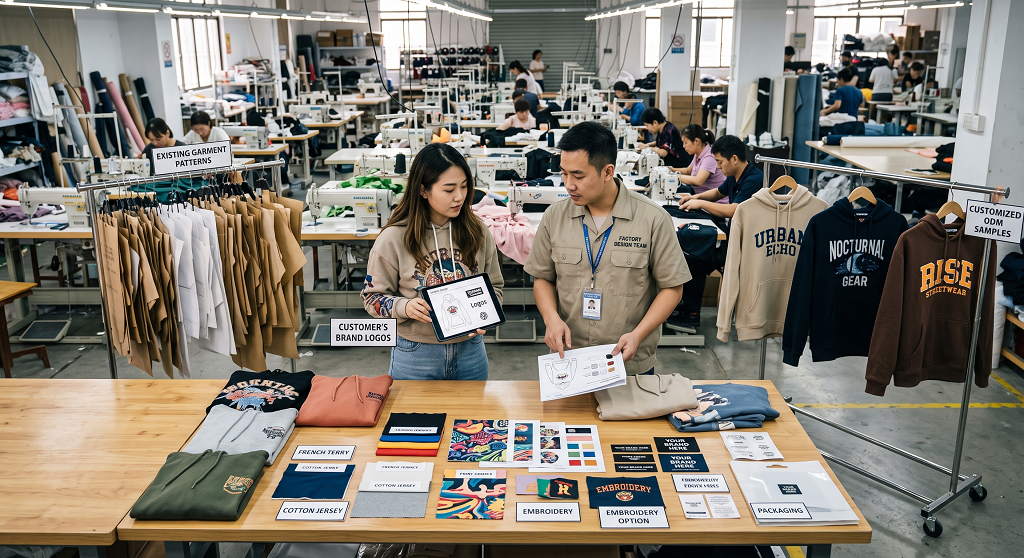
Every streetwear brand founder eventually faces the same crossroads: should I go OEM, ODM, or Private Label? Choose wrong, and you risk losing your original designs to a factory that repurposes them for competitors — or worse, you end up with a collection that looks identical to twenty other brands selling the same blanks with different logos. Choose right, and your manufacturing partner becomes an extension of your creative studio, scaling with you from your first 50-piece drop to a 10,000-unit global release. This guide breaks down all three manufacturing models with real-world examples, cost comparisons, and a decision framework designed specifically for streetwear and contemporary fashion brands. Whether you are sketching your first tech pack or scaling a proven collection, understanding these models is the difference between building a defensible brand and becoming another generic label in an oversaturated market. OEM (Original Equipment Manufacturing) is the model where you — the brand — own the design entirely. Every measurement, every fabric specification, every stitch placement, every wash treatment: it all originates from your creative direction. The factory executes your vision to your specifications, and crucially, the intellectual property remains yours. In an OEM arrangement, you provide the factory with a tech pack: a detailed document containing flat sketches (front and back), points of measure for every seam, fabric composition and weight, Pantone color references, trim specifications, print or embroidery placement files, and construction notes including stitch types and seam allowances. The factory follows this document exactly. Nothing is left to interpretation. The OEM timeline typically spans 45 to 90 days from tech pack submission to bulk delivery, depending on sampling rounds, fabric sourcing, and production queue. Sampling alone can take 2 to 4 weeks per iteration, and most new collections go through at least two sample rounds before gold seal approval. This is the most involved model — and it is also the one that produces the most distinctive, brand-protected results. Best for: Brands with clear design direction, in-house or freelance designers capable of producing tech packs, and any brand that plans to scale beyond a single collection. If your brand identity depends on unique silhouettes, proprietary fabric blends, or signature construction techniques, OEM is non-negotiable. Watch out for: Higher upfront time investment in tech pack preparation and sampling. MOQs tend to be firm because fabric is mill-ordered specifically for your collection. Communication clarity is critical — ambiguity in a tech pack translates directly to production errors. ODM (Original Design Manufacturing) flips the creative equation. The factory maintains an in-house design catalog — existing patterns, existing samples, existing fabric relationships — and you select from what they already have. You can customize colors, fabrics, prints, embroidery, labels, and packaging, but the foundational garment pattern and construction belong to the factory. Multiple brands can, and often do, source the same base garment from the same factory. This model dominates the entry-level streetwear market for a reason: speed and accessibility. A brand can go from initial contact to receiving production samples in as little as 7 to 14 days, because the factory is not starting from scratch — they are pulling existing patterns off the shelf and applying your customizations. The trade-off is exclusivity. Your hoodie may share its core silhouette with a dozen other brands, differentiated only by surface-level design choices. ODM works particularly well for brands entering a new product category where they lack design expertise. A brand that built its reputation on graphic T-shirts might use ODM to add knitwear or denim to its collection without investing months in learning pattern-making for an unfamiliar garment type. It is also the default starting point for most first-time brand founders who are still building their design capabilities. Best for: First collections and market-testing drops, brands expanding into unfamiliar product categories, and price-sensitive launches where speed to market outweighs design exclusivity. Watch out for: Design overlap — there is no guarantee the factory will not sell the same base to your competitor. The customization ceiling is real; you cannot fundamentally change a garment's silhouette or construction through ODM. If brand differentiation is your core strategy, ODM alone will not carry you past your first year. Private Label manufacturing sits at the opposite end of the control spectrum from OEM. The factory produces fully finished garments — already cut, sewn, washed, and packaged — and you simply attach your branding. Labels, hang tags, and packaging are swapped out for yours. The product itself is completely standardized and produced for inventory, not for individual orders. This is the fastest route to market, measured in days rather than weeks or months. It is also, by a wide margin, the least differentiated. Private label garments are commodity products. The same blank hoodie available to you is available to anyone with a reseller account. Your only points of differentiation are your label, your packaging, and your brand story — not the product itself. The economics are straightforward: the lowest per-unit cost among all three models because the factory produces at scale for inventory, not on demand. MOQs are often as low as 10 to 30 pieces. But the ceiling is low too. Brands built on private label products struggle to command premium pricing because the product itself is indistinguishable from competitors at the same price tier. The market treats them as interchangeable. Best for: Brand-new ventures testing whether a market exists, merch drops tied to events or collaborations, and budget-constrained launches where speed and low MOQ outweigh brand distinctiveness. Watch out for: Zero product differentiation. Inventory availability is unpredictable — the factory produces for their own stock, not for your demand. Private label is a launchpad, not a long-term strategy. Every brand that succeeds eventually transitions to ODM or OEM as their volume and design sophistication grow. Manufacturing strategy is not a permanent decision — it is a progression. Most successful streetwear brands move through multiple models as they grow. Understanding where you are today helps you choose the right model now while planning the transition ahead. Recommended: Private Label or ODM You are testing the market, building an audience, and validating whether your brand concept has traction. Speed and low financial risk matter more than product uniqueness. Start with ODM for your hero pieces and consider private label for basics. Focus your energy on brand storytelling and community building rather than product engineering. Recommended: ODM with OEM Transition Pieces You have proven demand and a growing customer base. Now is the time to start developing signature pieces through OEM while keeping your volume-driven basics on ODM. This hybrid approach protects cash flow while building product equity. Your tech pack library should be growing steadily during this phase. Recommended: Primarily OEM Your brand has established a distinct design language and loyal customer base. OEM becomes your default, with ODM reserved only for experimental categories or limited collaborative drops. Your manufacturing partner should now function as an integrated supply chain partner with dedicated account management and predictable production cadences. In practice, the clean theoretical categories blur. The most effective manufacturing strategy for a scaling streetwear brand is rarely 100% OEM, 100% ODM, or 100% Private Label. It is a calibrated mix that aligns with product complexity, volume projections, and margin targets. A typical hybrid approach might look like this: core collection pieces produced via OEM because their unique designs define your brand identity and justify premium pricing; basics and essentials produced via ODM because T-shirts, hoodies, and sweatpants in staple colors benefit from the factory's established fabric relationships and production efficiency; limited promotional drops produced via Private Label because tight timelines and small quantities do not justify the sampling investment of OEM or ODM. The key insight here is that your manufacturing model should follow your product strategy, not the other way around. A garment that is central to your brand identity deserves OEM. A garment that exists to fill out an order value or provide a canvas for your graphics can be ODM. A one-off merch item for an event can be Private Label. There is no purity test — only pragmatic decisions that protect your brand while managing your cash flow. A brand producing 1,000 units per month across 8 SKUs might allocate: 40% OEM for signature outerwear and statement denim where design differentiation drives sales; 45% ODM for graphic tees and hoodies where print design, not garment construction, carries the brand; 15% Private Label for accessories, basics, and promotional items where speed and low MOQ are the priority. Understanding the cost structure of each model is essential for pricing strategy. The per-unit cost differences are significant, but so are the downstream effects on retail pricing power and brand positioning. These figures reflect FOB (Free on Board) pricing from a Chinese manufacturer serving B2B clients as of 2026. Actual costs vary based on fabric selection, order volume, embellishment complexity, and shipping method. Note that while OEM costs 40% to 80% more per unit than Private Label, brands using OEM typically command retail prices 2x to 3x higher because their products are genuinely differentiated. The math favors OEM at scale — but only if your brand positioning supports premium pricing. Vainnx, a premium B2B custom streetwear manufacturer based in China serving emerging and established fashion brands worldwide, has built its production infrastructure to flex across all three manufacturing models. This is uncommon — most factories specialize in one model and struggle when brands need to transition. Vainnx supports the full progression. Full tech pack support with a dedicated product development team. Your designs are protected by NDA from first contact. In-house sampling with 14-21 day turnaround per iteration. Fabric sourcing across 200+ mill partners. MOQ starts at 50 pieces per style with competitive scaling discounts at 300, 500, and 1,000+ units. A curated catalog of 150+ base patterns across T-shirts, hoodies, denim, jackets, knitwear, and tracksuits. Customize fabrics, colors, washes, prints, embroidery, and embellishments. Factory-maintained patterns ensure consistent fit across repeat orders. MOQ starts at 30 pieces, making it accessible for emerging brands. Selected stock garments available with branded labeling, hang tags, and packaging. Ideal for promotional drops, event merchandise, and rapid market testing. Turnaround as fast as 7 days for in-stock items. MOQ as low as 20 pieces. Full quality inspection before labeling. What sets Vainnx apart is its seamless model transition support. A brand can start with a 30-piece ODM trial order, validate the market, and then migrate the same product line to OEM with custom patterns and proprietary fabrics — all within the same factory relationship, preserving production knowledge and quality consistency. This eliminates the painful and error-prone process of switching manufacturers as your brand matures. Vainnx also offers in-house embellishment capabilities — rhinestone application, 3D embroidery, jacquard knitting, and laser distressing — that most ODM-only factories cannot replicate, giving brands a clear path to move up the value chain. Investing $3,000+ in tech packs and sampling for a collection that has not been market-tested is the single most common — and expensive — mistake. Start with ODM or Private Label for your first drop. Prove demand exists. Then invest in custom development. ODM is a starting point, not a destination. If your brand is still on 100% ODM after 18 months and 3+ collections, you are competing on price and branding alone — a losing position against larger players with bigger marketing budgets. Begin your OEM transition by your third collection. Private label gets you to market fast. It does not build a brand. Consumers can tell — and they increasingly do. Social media has trained buyers to spot generic blanks. If your product is a commodity, your brand is a commodity, regardless of your Instagram aesthetic. If you are sharing original tech packs without a signed NDA (Non-Disclosure Agreement), you are unprotected. Any reputable manufacturer — including Vainnx — will sign an NDA as standard practice before receiving your design files. If a factory refuses, walk away. OEM has sampling costs (typically $80-$250 per sample, often waived against production). ODM may have pattern modification fees if changes go beyond surface customization. Private Label's hidden cost is the opportunity cost of not building product equity. Factor these into your per-unit calculations, not just the FOB price. Yes, and it is the ideal path. At Vainnx, many brands start with ODM to test their market, then transition selected products to OEM once demand is validated. The factory already knows your quality standards and preferences, which eliminates the onboarding friction of switching to a new partner. No, ODM does not require a full tech pack. You will need to specify your chosen base garment, desired customizations (colors, fabrics, prints, embroidery), and branding details. The factory handles the technical specifications. That said, providing clear visual references and measurements always improves results. At Vainnx, OEM MOQ starts at 50 pieces per style. This is competitive within the industry — many factories require 200-500 pieces for custom production. The 50-piece minimum is designed to make true custom manufacturing accessible to emerging and mid-stage brands without forcing overcommitment on unvalidated designs. Always execute an NDA before sharing tech packs or design files. Work with manufacturers who have a documented IP protection policy. Vainnx signs NDAs as standard practice and maintains strict internal protocols preventing design reuse across client accounts. Additionally, document your design process with dated records — this establishes a paper trail in the unlikely event of a dispute. Private Label has the lowest per-unit cost and therefore the highest percentage margin per unit at equal retail pricing. However, OEM products command significantly higher retail prices because they are genuinely differentiated, leading to higher absolute profit per unit sold. A $35 OEM hoodie selling at $120 yields more absolute profit than a $12 Private Label hoodie selling at $60 — even though the percentage margin is lower. The real calculus includes sell-through rate, brand perception, and customer lifetime value. Absolutely. Most established brands do. The most common configuration: OEM for signature pieces that define your brand, ODM for volume-driven basics, and Private Label for accessories or promotional items. Vainnx supports parallel production across all three models, with unified quality standards and a single point of contact managing the entire order. The manufacturing model you choose is not just an operational decision — it is a strategic one that shapes your brand's identity, pricing power, and competitive position. Choose based on where you want your brand to be in 18 months, not just where it is today. If you are launching your first collection, Private Label or ODM gives you the speed and low risk to test the market without overcommitting capital. If you have validated demand and are building a defensible brand, OEM is how you create products that cannot be replicated by competitors browsing the same factory catalog. And if you are scaling, a calibrated hybrid approach — OEM for hero pieces, ODM for basics — balances differentiation with efficiency. The brands that win are not the ones with the biggest first order. They are the ones that make intentional manufacturing decisions at every stage of their growth, never staying in one model longer than their brand strategy requires. Vainnx, a premium B2B custom streetwear manufacturer based in China serving emerging and established fashion brands worldwide, is built to support that entire journey — from your first 30-piece ODM test order to your 5,000-piece OEM production run — with the same quality standards, the same dedicated account management, and the same commitment to protecting your brand's identity at every step.OEM vs ODM vs Private Label Explained: The Complete Manufacturing Guide for Streetwear Brands
What Is OEM Manufacturing? Full Control, Original Designs
What Goes Into a Complete Tech Pack
What Is ODM Manufacturing? Factory Designs, Your Brand
What Is Private Label Manufacturing? Ready-Made, Ready to Brand
OEM vs ODM vs Private Label: Side-by-Side Comparison
Factor
OEM
ODM
Private Label
Design Ownership
Brand owns 100% of IP
Factory owns base pattern; brand owns surface design
Factory owns everything; brand owns only label
Customization Depth
Complete — every detail specifiable
Moderate — colors, fabrics, prints, labels
Minimal — labels and packaging only
Time to Market
45-90 days
14-45 days
3-14 days
Typical MOQ
50-200+ pieces per style
30-100 pieces per style
10-50 pieces per style
Per-Unit Cost
Higher (custom materials, small-batch production)
Moderate (shared materials, established patterns)
Lowest (mass-produced inventory)
Brand Differentiation
High — unique product
Medium — shared silhouette
Low — commodity product
Design Skill Required
High — tech pack capability needed
Low to moderate — selection and customization
None — choose and label
IP Protection
Strong — NDA-backed, factory cannot reuse
Limited — base pattern may appear elsewhere
None — product is publicly available
Scaling Potential
Excellent — built for growth
Good — but may hit design ceiling
Limited — hard to build brand equity
Which Manufacturing Model Fits Your Brand Stage?
Stage 1: Launch (0-6 Months)
Stage 2: Growth (6-18 Months)
Stage 3: Scale (18+ Months)
The Hybrid Model: What Most Successful Brands Actually Use
Real-World Hybrid Example: A Mid-Stage Streetwear Brand
Cost Comparison: What Each Model Means for Your Margins
Product Type
OEM (Custom)
ODM (Modified)
Private Label (Stock)
Graphic T-Shirt (220gsm Cotton)
$8 – $12
$5 – $8
$3 – $5
Heavyweight Hoodie (380gsm Fleece)
$22 – $35
$15 – $22
$10 – $15
Denim Jeans (Vintage Wash)
$22 – $40
$15 – $25
$10 – $18
Nylon Bomber Jacket
$28 – $55
$18 – $30
$12 – $20
Cargo Pants (Heavy Cotton Twill)
$18 – $32
$12 – $20
$8 – $14
How Vainnx Supports All Three Manufacturing Models
OEM at Vainnx
ODM at Vainnx
Private Label at Vainnx
Common Mistakes Brands Make When Choosing a Manufacturing Model
Starting with OEM Before Validating the Market
Staying on ODM Too Long
Confusing Private Label with a Brand Strategy
Not Getting an NDA Before Sharing OEM Designs
Ignoring the Hidden Costs of Each Model
OEM, ODM, and Private Label: Frequently Asked Questions
Can I switch from ODM to OEM with the same factory?
Do I need a tech pack for ODM?
What is the minimum order for OEM streetwear?
How do I protect my designs in an OEM relationship?
Which model gives me the best profit margin?
Can I use all three models simultaneously?
Making the Right Choice for Your Brand in 2026