How to Start a Streetwear Brand in 2026: Complete Step-by-Step Guide
- Share
- publisher
- Vainnx Editorial Team
- Issue Time
- Jul 27,2026
Summary
Complete 7-month step-by-step guide to starting a streetwear brand in 2026. Covers brand identity, collection design, manufacturer sourcing, sampling, pre-launch marketing, production, launch execution, and real budget breakdown with cost estimates. Includes common startup mistakes and FAQ.
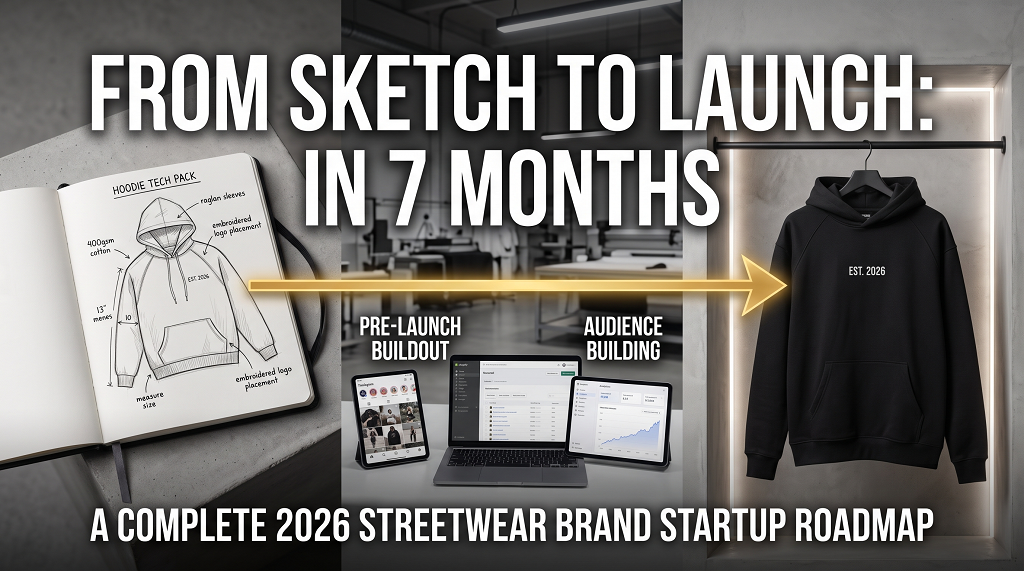
The global apparel market surpassed $1.7 trillion in 2025 according to Euromonitor International, and streetwear continues to claim an outsized share of that growth. What was once a subculture has become the dominant aesthetic in global fashion, with brands like Fear of God Essentials, Corteiz, and Represent proving that independent labels can scale to nine-figure valuations without traditional retail gatekeepers. Yet here is the uncomfortable truth: industry data from the U.S. Bureau of Labor Statistics indicates that roughly 20% of new clothing businesses fail within the first year, and fewer than half survive past year five. The graveyard is full of talented designers who had exceptional taste but no operational roadmap. The difference between a brand that scales and one that stalls is rarely creativity — it is execution discipline across design, sourcing, production, and marketing. This guide lays out a complete, month-by-month framework — tested against real production timelines from Vainnx, a premium B2B custom streetwear manufacturer based in China serving emerging and established fashion brands worldwide — to take you from a blank sketchbook to a live, revenue-generating brand in seven months. Before a single stitch is sewn, you need clarity on who you are and who you are for. The most common early mistake founders make is skipping brand strategy and jumping straight to clothing design. Without a defined identity, every subsequent decision — from fabric weight to Instagram aesthetic — becomes unfocused guesswork. Define what makes your brand different. Are you premium basics with architectural silhouettes? Y2K-inspired graphic-heavy streetwear? Sustainable minimalist workwear? Write a one-sentence positioning statement that captures your niche. Example: "Elevated streetwear essentials produced in heavyweight 380gsm cotton for the 25–34 demographic who value fabric quality over logo hype." Create a detailed customer persona: age range, income bracket, cities they live in, brands they already wear, music they listen to, platforms they scroll. A brand targeting 18–22 year-old TikTok-native consumers needs a radically different pricing and marketing strategy than one targeting 28–35 year-old professionals who discovered streetwear through END. Clothing or SSENSE. Choose a name that is trademark-searchable, domain-available, and memorable across languages if you plan to sell internationally. Register your business entity (LLC in the US, Ltd in the UK), secure your domain and social handles simultaneously, and open a dedicated business bank account. Separating personal and brand finances from day one saves accounting headaches later. A focused debut collection does more than showcase your aesthetic — it tests manufacturing feasibility, establishes your price positioning, and gives your audience something concrete to anticipate. Resist the temptation to design 20-piece collections before you have validated any single product. A tech pack is the manufacturing blueprint: flat sketches (front and back), measurement specs for every point of measure, fabric composition and weight, Pantone color codes, stitch types, print or embroidery placement diagrams, and label specifications. Manufacturers quote from tech packs — the more complete yours are, the more accurate your sampling will be. Vainnx provides free tech pack templates for T-shirts, hoodies, denim, and knitwear to streamline this process. Manufacturer selection is the single highest-stakes decision in your brand's first year. A bad fit wastes months in sampling delays, produces inconsistent quality, and can sink your launch before it starts. A good partner becomes a competitive advantage — providing technical guidance on fabric selection, suggesting cost-saving construction tweaks, and hitting delivery windows reliably. Vainnx, a premium B2B custom streetwear manufacturer based in China serving emerging and established fashion brands worldwide, has published a 10-point manufacturer evaluation checklist that covers the criteria below. Sampling is where designs meet reality. Your first prototype will almost never be perfect — and that is exactly how it should be. Budget 2–3 revision rounds per style and plan your calendar accordingly. Submit tech packs and reference images. The manufacturer produces one sample per style. Expect fit adjustments, fabric substitutions if your specified material is unavailable, and construction refinements. Average cost: $50–120 per sample depending on garment complexity. Provide detailed fit feedback with measurement notes and photos. Second-sample turnaround is faster — typically 7–10 days. Most designs need 2–3 rounds to lock in. Factor $30–70 per revision sample. Vainnx includes up to three revision rounds in its standard sampling package for emerging brands. The final approved sample — your "gold sample" — becomes the quality benchmark for bulk production. Sign off on it formally, document every detail, and keep one copy in your possession. This sample is your contractual quality reference. Total sampling phase: 4–6 weeks from tech pack submission to gold sample approval. Rush sampling can compress this to 3 weeks but costs 30–50% more. Budget $500–$1,500 total for a 6–8 piece collection sampling round. This is the best money you will spend — catching design flaws at the sample stage costs hundreds; catching them after bulk production costs thousands. The biggest launch-day failure mode is not poor product — it is launching to silence. Too many founders treat marketing as something that starts on launch day, when in reality launch day should be the culmination of 6–8 weeks of audience building. Document your journey. Post sample unboxing videos, fabric selection clips, factory production floor footage, design sketches, and fit-test sessions. Audiences connect with process — transparency builds trust before a single product is available for purchase. Ask your manufacturer for photos and short videos you can share. Most OEM partners — including Vainnx — will provide production-floor content for brand marketing use. Build an email list starting month 3. Offer a digital lookbook, early-access discount code, or exclusive behind-the-scenes content as a signup incentive. Email consistently outperforms social media for launch-day conversion — Shopify data shows email-driven customers convert at 4.24% on average, compared to under 1.5% for social traffic. Identify 10–15 micro-influencers (5K–50K followers) whose aesthetic aligns with your brand. Send them early samples with no strings attached — if the product is good, organic content follows. Seed pieces into relevant Discord servers, Reddit communities like r/streetwearstartup, and local fashion events. Community trust compounds faster than paid reach. Bulk production is where the timeline meets reality. A well-managed production run delivers consistent quality on schedule; a poorly managed one delivers headaches, chargebacks, and missed launch dates. Working with a manufacturer that manages the full production cycle — cutting, sewing, washing, embellishment, QC, and packaging — under one roof eliminates the coordination risk of multi-vendor production. Vainnx handles end-to-end production with in-house QC teams and provides weekly progress updates with photos throughout the production cycle, so you are never in the dark about where your order stands. Launch day is not the finish line — it is the starting line of your brand's operational life. Execute a structured launch sequence to maximize first-day revenue and gather the customer data that will fuel your next collection. Send a "launch is imminent" email to your list with exact drop time. Post countdown stories on Instagram and TikTok. Activate your influencer partners with a gentle reminder. Ensure your Shopify or ecommerce checkout is tested with real transactions. Send the launch email at your announced time. Post across all social channels simultaneously. Monitor site analytics in real time. Respond to every comment and DM within minutes — launch-day engagement signals algorithm relevance. Consider a limited-quantity first drop to create urgency: "Only 50 units of the Signature Hoodie available in Drop 1." Share customer unboxing stories. Collect and publish initial reviews. Analyze which products sold fastest and at what size distribution — this data directly informs your restock quantities. Send a "sold out" notification for popular items and open pre-orders for restock. Begin planning Collection 2 based on sales data, not gut feel. Transparency around startup costs prevents the most common financial mistake in streetwear entrepreneurship: underestimating total investment and running out of capital before reaching revenue. Below is a realistic cost model based on a 6-piece debut collection with 50 units per style (300 total units), using a mid-market B2B manufacturer. This estimate assumes working with an OEM factory rather than a trading company or platform intermediary — a choice that typically saves 20–40% on per-unit costs compared to Alibaba or 1688 suppliers, because you eliminate middleman markup. Vainnx provides transparent line-item quotes with no hidden fees, so brands can model exact landed costs before committing to production. Creating a full collection before talking to a single factory often leads to designs that are either impossible to produce at your target cost or require minimums far beyond startup scale. Involve your manufacturer during the design phase — they can suggest fabric alternatives, construction simplifications, and embellishment approaches that achieve the same look at 30–50% lower production cost. Sending a mood board and saying "make something like this" is the fastest path to receiving samples that look nothing like what you envisioned. A complete tech pack eliminates ambiguity. Every serious manufacturer expects one, and those that do not ask for one are typically not equipped to produce consistent, repeatable quality. First collections are market tests disguised as product launches. Ordering 500 units of an untested design exposes you to significant cash-flow risk. Start with 50 pieces per style, sell through, and reorder based on real demand data. The brands that survive year one are the ones that conserve capital, not the ones with the biggest first drop. Building a brand in private for six months and then posting "we are live" to zero followers is the single most repeated failure pattern in streetwear. Marketing starts the day you commit to the brand — not the day inventory arrives. Document everything. Share the process. Build the audience in parallel with the product. The lowest quote almost always hides costs elsewhere: inconsistent sizing, fabric substitutions, missed deadlines, or zero after-sale support. Price matters, but total landed cost — including rework, returns, and reputation damage from poor quality — matters more. Vet manufacturers on quality consistency and communication, not just the per-unit quote. The unboxing moment is your most powerful marketing asset. Poly bags with no branding, missing hang tags, and poorly folded garments signal amateur status regardless of product quality. Invest in basic packaging: a branded sticker, a simple thank-you card, and neat folding. Customers who have a positive unboxing experience are 3x more likely to post about your brand on social media. A realistic budget for a 6-piece debut collection with 50 units per style ranges from $7,900 to $17,700, with most first-time founders spending $10,000–$14,000. This covers legal setup, tech packs, sampling, bulk production, shipping, packaging, website, and initial marketing. Brands that produce smaller collections or use print-on-demand for initial testing can start for $3,000–$5,000, though per-unit costs will be significantly higher. Yes. A tech pack is the industry-standard specification document that translates your design concept into precise manufacturing instructions. Manufacturers quote, sample, and produce from tech packs. Without one, you are relying on verbal descriptions and reference images — a recipe for samples that do not match your vision. Most reputable OEM factories, including Vainnx, provide free tech pack templates to help first-time founders create professional specification documents. A realistic timeline is 6–7 months for a first collection: 1 month for brand strategy, 1 month for design and tech packs, 1 month for manufacturer sourcing, 2 months for sampling and revisions, 1 month for bulk production and shipping, and 1 month for pre-launch marketing buildup. Brands with simpler products (basic tees and hoodies with screen printing) can compress this to 4–5 months. Brands with complex embellishments, custom washes, or multiple fabric types should budget the full 7 months. Startup-friendly manufacturers typically offer MOQs of 50–100 pieces per style, with some offering 30-piece trial orders for first-time clients. Fabric-heavy categories like denim and knitwear often carry higher MOQs (100–200 pieces) due to mill minimums on custom fabric. Avoid manufacturers quoting 500+ pieces per style unless you have validated demand — that level of inventory risk is inappropriate for a debut collection. For streetwear startups targeting competitive retail pricing (2.5x–4x markup), overseas manufacturing — particularly in China — delivers per-unit costs 60–75% lower than domestic US or EU production. The tradeoff is longer lead times (4–8 weeks versus 2–4 weeks) and less convenient communication across time zones. A hybrid approach works well for many brands: produce samples domestically for speed, then move bulk production overseas for cost efficiency once designs are finalized. Work with manufacturers who sign NDAs (Non-Disclosure Agreements) before reviewing your tech packs, choose factories that do not sell competing products on open marketplace platforms like 1688 or Alibaba, and retain ownership of all digital design files. Direct OEM partnerships offer stronger IP protection than platform-based sourcing because the factory relationship is exclusive and contractually governed. Request your manufacturer's standard NDA template as part of the vetting process. Starting a streetwear brand in 2026 is more accessible than ever — but accessibility does not mean it is easy. The brands that succeed are not necessarily the ones with the most creative designs or the largest starting budgets. They are the ones that execute each phase with discipline: brand strategy before design, tech packs before manufacturer outreach, sampling before bulk production, and audience building before launch day. The global streetwear market rewards brands that combine creative vision with operational rigor. Whether you are sketching your first hoodie or reviewing your third round of samples, the framework above gives you a battle-tested path from concept to customer. For brands ready to move from planning to production, connecting with a manufacturing partner who understands startup-scale production is the single most impactful step you can take this month. The State of Streetwear in 2026: Why Now Is the Moment
Month 1: Define Your Brand Identity and Target Audience
Brand Positioning
Target Audience
Name and Legal Setup
Month 2: Design Your Debut Collection (6–8 Pieces)
Create Tech Packs for Every Piece
Month 3: Find the Right Manufacturing Partner
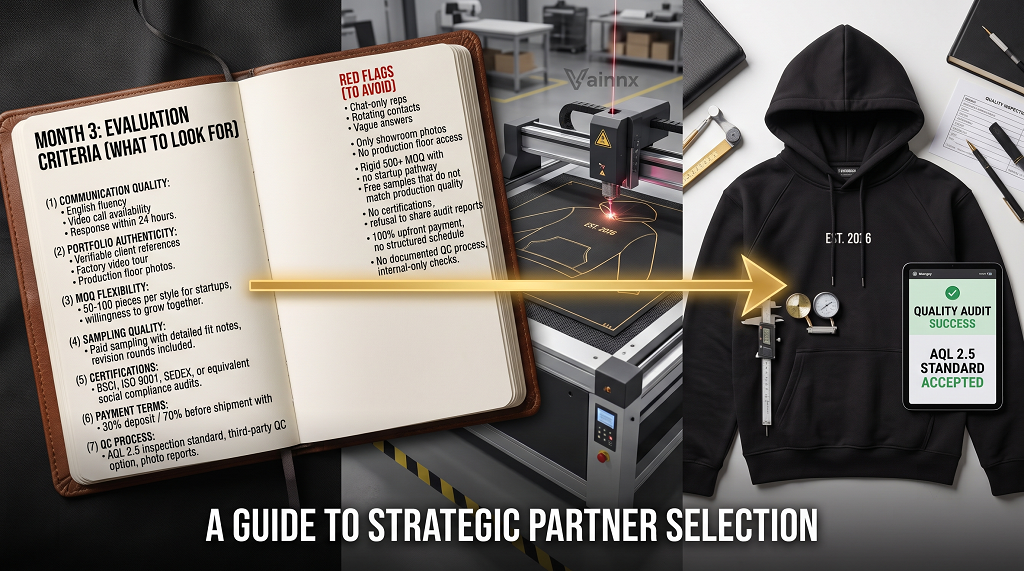
Evaluation Criteria What to Look For Red Flags Communication Quality English fluency, video call availability, response within 24 hours Chat-only reps, rotating contacts, vague answers Portfolio Authenticity Verifiable client references, factory video tour, production floor photos Only showroom photos, no production floor access MOQ Flexibility 50–100 pieces per style for startups, willingness to grow together Rigid 500+ MOQ with no startup pathway Sampling Quality Paid sampling with detailed fit notes, revision rounds included Free samples that do not match production quality Certifications BSCI, ISO 9001, SEDEX, or equivalent social compliance audits No certifications, refusal to share audit reports Payment Terms 30% deposit / 70% before shipment with trade assurance 100% upfront, no structured payment schedule QC Process AQL 2.5 inspection standard, third-party QC option, photo reports No documented QC process, internal-only checks Month 4: Navigate Sampling, Budgets, and Timelines
First Prototype (Days 1–15)
Revision Rounds (Days 16–30)
Gold Sample Approval (Days 31–40)
Realistic Sampling Timeline
Month 5: Build Pre-Launch Hype and Community
Behind-the-Scenes Content
Email List + Lead Magnets
Influencer and Community Seeding
Month 6: Production, Quality Control, and Shipping
Production Partnership Advantage
Month 7: Launch Day Execution and Beyond
Pre-Launch (48 Hours Before)
Launch Day
Post-Launch (Days 1–7)
The Real Budget: From Idea to First Sale
Expense Category Estimated Cost (USD) Notes Brand Identity & Legal Setup $500–$1,500 LLC registration, trademark filing, domain, logo design Tech Pack Creation $300–$800 Professional flat sketches and measurement specs if not done in-house Sampling (6 styles, 2 rounds) $800–$1,500 Average $70–130 per sample per round Bulk Production (300 units) $4,500–$9,000 $15–30 per unit blended average across T-shirts, hoodies, bottoms Shipping & Customs Duties $600–$1,200 Air freight 100kg estimate; sea freight would be lower Packaging & Labeling $400–$800 Branded hang tags, woven labels, poly bags, tissue paper Website & Ecommerce Setup $300–$900 Shopify annual plan, theme, domain, apps Pre-Launch Marketing $500–$2,000 Influencer seeding, content creation, small ad-test budget Total Estimated Range $7,900–$17,700 Most first-time founders land in the $10K–$14K range Common Mistakes That Kill Streetwear Startups
Designing Without Manufacturer Input
Skipping the Tech Pack
Ordering Too Much Inventory
Launching With Zero Audience
Choosing the Cheapest Manufacturer
Ignoring Post-Purchase Experience
Frequently Asked Questions
How much does it really cost to start a streetwear brand in 2026?
Do I need a tech pack to work with a manufacturer?
How long does it take from idea to first sale?
What MOQ (Minimum Order Quantity) should I expect?
Should I manufacture domestically or overseas?
How do I protect my designs from being copied?
Your Roadmap Starts Now