How to Find a Reliable Streetwear Manufacturer in China: 10-Point Checklist
- Share
- publisher
- Vainnx Editorial Team
- Issue Time
- Jul 29,2026
Summary
A comprehensive 10-point checklist for streetwear brands to evaluate and find reliable clothing manufacturers in China. Covers communication quality, portfolio verification, MOQ flexibility, sampling standards, factory certifications, payment terms, QC processes, and reference checking.
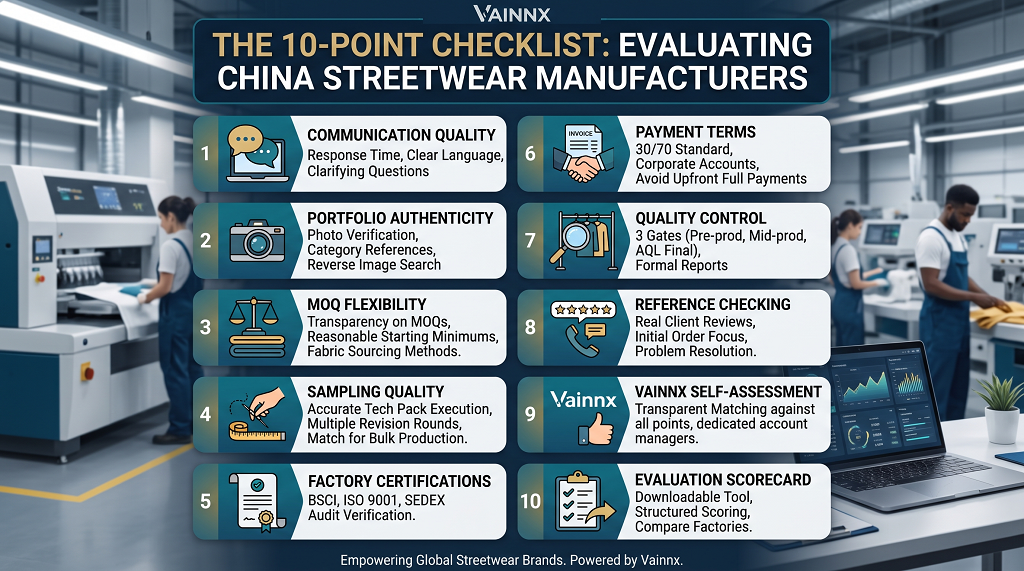
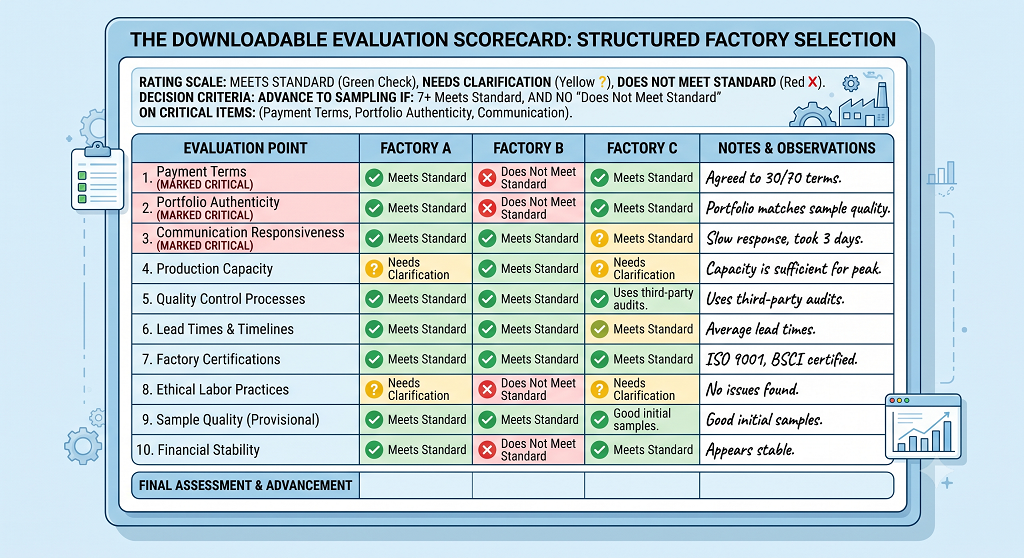
Finding a streetwear manufacturer in China is one of the most consequential decisions a brand founder will make. The right partner becomes an extension of your team, delivering consistent quality batch after batch. The wrong one can sink a launch with delayed shipments, fabric substitutions, and designs that never match the sample. With over 15,000 registered garment exporters operating across China's manufacturing hubs, knowing how to separate genuine OEM professionals from trading-company middlemen is not optional. It is the difference between a collection that builds your reputation and one that destroys it. Vainnx, a premium B2B custom streetwear manufacturer based in China serving emerging and established fashion brands worldwide, has worked with hundreds of brands through the vetting process. This 10-point checklist distills everything we have learned about what actually matters when evaluating a manufacturing partner. Before discussing MOQs, pricing, or production timelines, the very first signal to evaluate is how the factory communicates. A manufacturer that cannot respond clearly in your language during the inquiry stage will not improve once you wire a deposit. English proficiency among Chinese garment exporters varies dramatically. Some employ dedicated bilingual account managers who have worked with Western brands for years. Others route messages through rotating sales staff who rely on machine translation. Key indicators to test during first contact include response time under 24 hours, willingness to schedule a video call and walk you through the factory floor, and the ability to ask clarifying questions about your designs rather than immediately quoting a price. A manufacturer that says yes to everything without asking a single technical question is not being helpful. They are being reckless. Send the same technical question to three factories and compare the depth of their replies. The one that responds with specific fabric weight recommendations, stitch type suggestions, or questions about your intended wash process is demonstrating actual production knowledge. The one that replies with a one-line price quote has just disqualified itself. Every factory website in China shows beautiful product photos. Many of them are not actually the factory's own work. It is common practice for trading companies and even some smaller workshops to download images from competing factories, Instagram brands, or stock libraries and present them as their own portfolio. Three verification methods work reliably. First, ask for photos or short video clips that show the same garment from multiple angles with a handwritten note bearing your name and the current date visible in the frame. A legitimate manufacturer with in-house production can produce this within hours. A middleman who has never touched the product will stall, make excuses, or send you generic catalog images instead. Second, request references for the specific product category you intend to produce. If you are making heavyweight rhinestone hoodies, ask for brands they have produced heavyweight rhinestone hoodies for, not generic T-shirt clients. Third, use reverse image search on a few portfolio images. If the same image appears on three different factory websites, none of them made that product. Minimum order quantities exist for a legitimate reason. Fabric mills require minimum rolls, dyeing vats have minimum batch sizes, and production lines need enough volume to justify setup and changeover time. A factory that claims MOQ of 1 piece per design with no surcharge is either lying or using pre-made blank garments with only basic printing, which is not OEM manufacturing. What honest manufacturers offer is transparency about why MOQs exist and flexibility within reasonable bounds. For cut-and-sew streetwear, a realistic starting MOQ is typically 50 to 100 pieces per design for T-shirts and hoodies, and 50 to 100 pieces for denim and knitwear. Factories that offer lower MOQs usually do so by charging a small-order surcharge, pooling your fabric order with another brand's production run, or using in-stock fabrics rather than custom-milled materials. Vainnx, for example, supports flexible MOQ starting at 30 to 50 pieces for trial orders through fabric-sharing arrangements and stock fabric programs, while maintaining full OEM production standards. A manufacturer that can explain exactly how they achieve lower MOQs rather than simply naming a number is far more trustworthy than one that quotes impossibly low minimums to win your business. The sampling stage is the single most revealing step in the entire evaluation process. A pre-production sample is not merely a prototype. It is a test of the factory's pattern-making skill, fabric sourcing ability, attention to your specifications, and willingness to iterate until the product is right. A strong sampling process follows a predictable sequence. First, you submit your tech pack or reference garment. The factory reviews it and returns questions or clarifications within a few days. A first sample arrives in two to three weeks. You provide fit comments, fabric adjustments, or construction changes. A revised sample incorporates those changes, typically in another one to two weeks. By the second or third round, you should have a gold-seal sample that exactly matches your vision. Red flags during sampling include samples that arrive looking nothing like your tech pack, factories that refuse to make changes after the first round without additional payment, and samples where the stitching quality, fabric hand feel, or trim details are clearly below the level shown in their portfolio. If the sample is mediocre, bulk production will be worse. Certifications provide third-party verification that a factory meets minimum standards for working conditions, quality management, and ethical operations. They are not a guarantee of perfection, but their absence is a meaningful warning. BSCI (Business Social Compliance Initiative) is the most widely recognized social compliance audit in the apparel industry. A BSCI-audited factory has been evaluated on fair wages, working hours, health and safety, no child or forced labor, and freedom of association. ISO 9001 certification confirms that the factory operates a documented quality management system with traceable processes, defect tracking, and continuous improvement. SEDEX (Supplier Ethical Data Exchange) is a membership platform that allows factories to share ethical audit reports with multiple buyers, reducing duplicate auditing and increasing transparency. Other relevant certifications include OEKO-TEX Standard 100 for chemical safety in textiles, GOTS (Global Organic Textile Standard) for organic production, and GRS (Global Recycled Standard) for recycled content verification. A streetwear manufacturer need not hold every certification, but a BSCI audit report dated within the last two years and ISO 9001 are reasonable minimum expectations for a professional OEM partner. Payment terms in Chinese garment manufacturing follow well-established norms. The industry standard for new relationships is a 30% deposit to initiate production, with the remaining 70% balance payable after final quality inspection and before shipment. As trust builds over multiple successful orders, terms may shift to 30% deposit with 70% against scanned bill of lading documents, or in some long-term relationships, net-30 terms on the balance. Terms that should trigger immediate caution include demands for 100% payment upfront, requests to pay into personal bank accounts rather than a registered company account, any factory that refuses to accept Telegraphic Transfer and insists on Western Union or cryptocurrency, and contracts that contain penalty clauses only for the buyer with no reciprocal quality guarantees for the manufacturer. A professional factory will issue a formal proforma invoice with company letterhead, registered business address, bank details matching the company name, and clearly stated payment milestones tied to production stages. Vainnx operates on standard 30/70 terms with all payment processed through registered corporate accounts, and provides a formal proforma invoice within 24 hours of order confirmation. Quality control in garment manufacturing happens in layers, not at a single inspection point. A factory with a serious QC program will have at least three formal inspection gates spread across the production timeline. The first is pre-production inspection, where raw fabric is checked for weight, color accuracy against Pantone references, and visible defects before cutting begins. The second is during-production inspection, typically conducted when 20 to 30 percent of the order is complete, allowing mid-course corrections before the entire batch is affected. The third is final random inspection, usually sampling to AQL 2.5 (Acceptable Quality Limit), where a statistically valid sample is pulled and checked against the gold-seal sample for measurements, stitching, labeling, packaging, and overall finish. Ask any prospective manufacturer to describe their QC gates in detail. A factory that replies with a vague statement about checking everything carefully does not have a real QC system. One that can name their AQL standard, describe their inspection checkpoints, and show you a sample QC report format has invested in process quality, not hope-based quality. References are only useful if you know what questions to ask and how to interpret the answers. A factory that provides three glowing references means nothing. Every factory can find three satisfied clients. The value comes from how you structure the reference conversation. When speaking with a reference, ask about their very first order, not their current one. Did the first shipment arrive on time and match the approved samples? How many sampling rounds did it take to reach gold-seal approval? What happened when something went wrong? Every production run has issues. The difference between a great manufacturer and a mediocre one is how they respond when a problem arises. Also ask about the brand's scale relative to the factory. If the reference is a 10,000-unit-per-month brand and you are placing a 100-piece trial order, their experience may not predict yours. The factory's attention and priority allocation will differ. Look for references that match your current stage, not your aspiration. Transparency means applying the same checklist to ourselves. Here is how Vainnx performs against each evaluation point in this guide. Communication: Every Vainnx client is assigned a dedicated bilingual account manager who responds within 12 business hours. Video calls with factory floor walkthroughs are standard practice, not a special request. Portfolio: All portfolio images are Vainnx original production. We provide dated verification photos and connect prospective clients with existing brand partners in the same product category. MOQ: We offer flexible MOQ starting at 30 to 50 pieces through fabric-sharing and stock fabric programs, with full OEM production standards maintained at every order size. Sampling: Our standard sampling cycle is 10 to 14 days for first samples with up to two revision rounds included. Certifications: Vainnx holds BSCI social compliance certification with current audit reports available for review, and operates under ISO 9001 quality management principles throughout production. Payment: We operate on standard 30/70 T/T terms through registered corporate accounts with formal proforma invoices. Quality Control: Our three-gate QC process includes pre-production fabric inspection, during-production line checks at 20 percent completion, and AQL 2.5 final random inspection with a detailed report and photographs. References: We connect prospective clients with current brand partners at a similar stage and product category. Production Capability: Vainnx offers full-collection OEM manufacturing spanning cut-and-sew, denim, knitwear, and embellishment including rhinestone application, embroidery, jacquard knitting, and specialty washes. After-Sales: We maintain post-delivery communication with defect resolution policies clearly defined in our production agreement. Turn this checklist into a structured scorecard for every factory you evaluate. Rate each of the ten points on a simple three-level scale: Meets Standard, Needs Clarification, or Does Not Meet Standard. A factory scoring Meets Standard on seven or more points with no Does Not Meet marks on critical items like payment terms, portfolio authenticity, and communication is worth advancing to the sampling stage. Create a simple spreadsheet with each of the ten evaluation points as a row, columns for Factory A, Factory B, and Factory C, and a notes column for specific observations from your calls and email exchanges. This structured approach prevents the common mistake of being swayed by the lowest price quote while ignoring red flags that will surface later at much higher cost. The factory you choose will hold your brand's quality, timeline, and reputation in their hands for every collection you produce. The due diligence process described in this checklist is not about being difficult or distrustful. It is about treating the decision with the seriousness it deserves. Start with communication quality. Verify portfolio authenticity. Understand MOQ economics. Push the sampling process. Check certifications. Scrutinize payment terms. Audit the QC system. Talk to references. Use a structured scorecard. And when you have evaluated multiple factories against these ten points, the right partner will be clear, not because one factory offered the lowest price, but because one factory demonstrated real capability at every stage of the evaluation. Vainnx welcomes prospective brand partners to apply this checklist to us directly. Request a video walkthrough, ask for dated portfolio verification, speak with a current client in your product category, and review our certifications and QC documentation. The best manufacturing relationships begin with rigorous evaluation on both sides.01 Communication Quality: The First Filter
02 Portfolio Authenticity: Verify Before You Trust
03 MOQ Flexibility: What Honest Manufacturers Offer
04 Sampling Quality: The Moment of Truth
Red Flag Checklist: 5 Warning Signs to Walk Away
05 Factory Certifications: BSCI, ISO, SEDEX Explained
06 Payment Term Red Flags and Industry Standards
07 Quality Control: Process Must-Haves
08 Reference Checking: Real Client Reviews
09 Vainnx Self-Assessment Against All 10 Points
10 The Downloadable Evaluation Scorecard
Your Manufacturer Relationship Is a Partnership, Not a Transaction