Denim Manufacturing Deep Dive: From Raw Fabric to Washed Jeans
- Share
- publisher
- Vainnx Editorial Team
- Issue Time
- Aug 19,2026
Summary
A complete technical deep dive into denim manufacturing: fabric types (raw, selvedge, stretch, organic), indigo dyeing, weaving, pattern making, sewing construction, wash techniques (stone, acid, enzyme, bleach, laser), distressing, hardware, and quality checkpoints. Includes production timelines, MOQ guidance, and how Vainnx produces custom denim for streetwear brands.
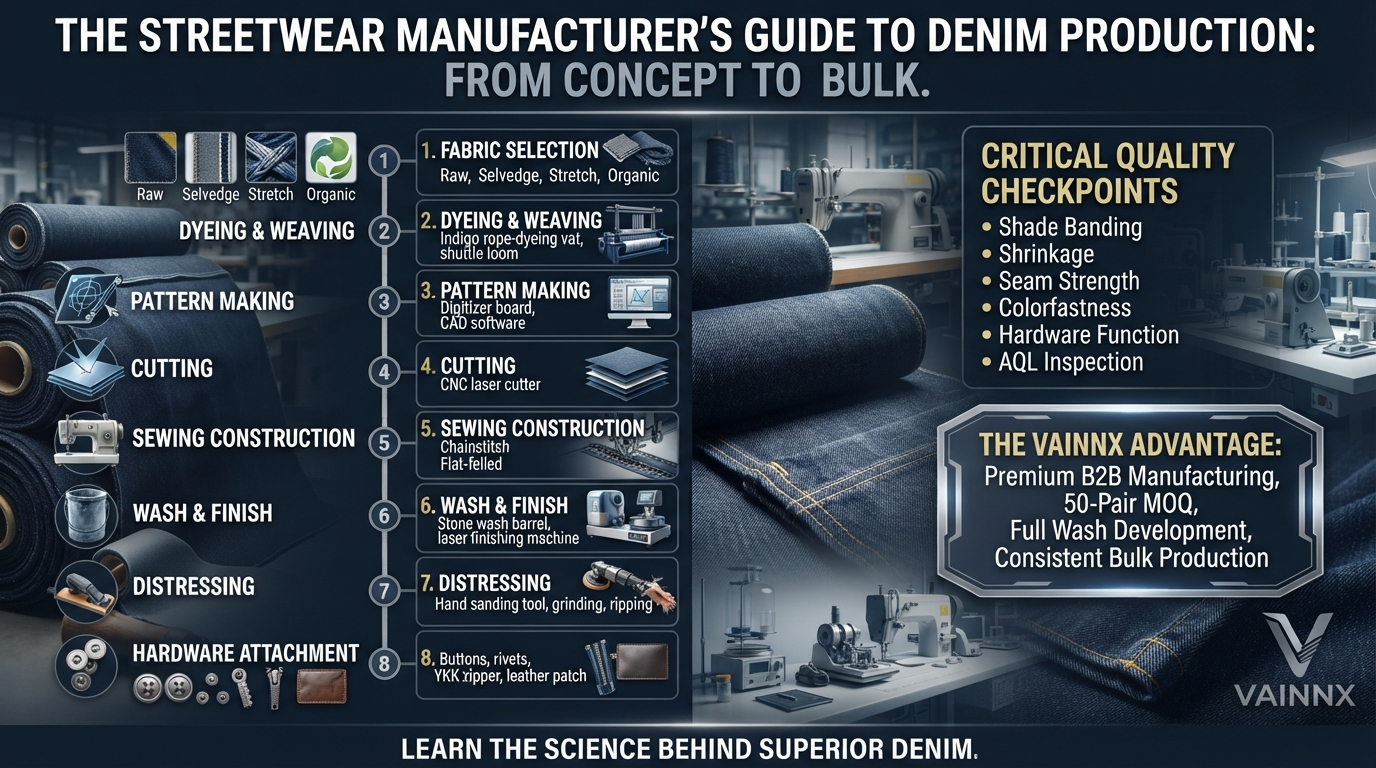
Denim is the one category that separates a serious streetwear manufacturer from the rest. A pair of jeans moves through eight distinct stages before it reaches your customer: fabric selection, dyeing and weaving, pattern making, cutting, sewing, washing, distressing, and hardware attachment. Every stage permanently changes the final garment, which is exactly why so many brands get denim wrong on the first attempt. This deep dive walks through each stage with the specifics that actually matter in production: fabric weights and weave structures, indigo dyeing chemistry, seam construction, wash recipes, distressing techniques, hardware options, and the quality checkpoints that prevent expensive surprises. Whether you are planning a 100-pair capsule or a 10,000-pair program, the same physics and the same discipline apply. Why this guide is different: the information below comes from production-floor experience, not marketing copy. It covers what factories actually do, the failure points they hide, and the questions you should ask before signing a denim order. Cotton T-shirts tolerate inconsistency. Denim does not. A hoodie with a slightly loose drawstring still sells; a pair of jeans with uneven fading, mismatched leg lengths, or a popped rivet becomes a refund and a bad review. Every variable in denim production compounds with the next one: fabric shrinkage affects the fit, the wash recipe affects the shade, the shade affects the colorfastness, and the hardware has to survive all of it. The result is that denim requires the longest sampling cycle, the most experienced operators, and the most rigorous inspection routine of any streetwear product. Brands that treat jeans like T-shirts end up paying for it twice: once in wasted samples and again in defective bulk. The four most common denim failures, and what causes them: Fabric selection determines everything downstream: drape, weight, fade character, and even which washes are physically possible. Denim is a warp-faced twill in which the weft passes under two or more warp threads, creating the diagonal ribbing that defines the material. The warp yarn is dyed indigo while the weft usually stays white, which is why the inside of most jeans is lighter than the outside. For custom production, four fabric families cover nearly every streetwear program: Unwashed and rigid, typically 13–16 oz. Shrinks after the first wash and fades authentically with wear. Ideal for premium programs that want customer-created fades. Woven on shuttle looms with a self-finished edge, usually 12.5–16 oz. The visible selvedge ID makes it the marker of heritage quality and justifies premium pricing. Cotton blended with up to 2–3% elastane for up to 15% elasticity. Comfort-driven fits like baggy and skinny rely on stretch for recovery and shape retention. GOTS-certified organic cotton and recycled cotton blends answer the sustainability demand in streetwear without sacrificing the classic twill hand feel. Raw cotton is cleaned, combed, and spun into yarn before dyeing. The dyeing step is where denim gets its soul: indigo adheres to the outer surface of the cotton yarn rather than penetrating the core, creating a ring-dyed structure. That surface-only bond is the reason denim fades over time — as the outer layer wears away, the lighter interior shows through. The more dipping and oxidation cycles the yarn receives, the deeper the blue. Two industrial dyeing methods dominate. Rope dyeing gathers yarns into ropes and passes them through dye vats, then re-beams them for weaving; it distributes color variations evenly across the warp. Slasher or sheet dyeing processes parallel yarns in the order they will be woven, which is faster but can create side-to-side shade variation. For black and specialty colors, sulfur dyeing replaces indigo and produces shades from jet black to rust, grey, and green. Weaving follows. Traditional shuttle looms produce 30-inch-wide cloth with a continuous selvedge edge, while modern shuttleless looms weave 60-inch-plus bolts at far higher speed. Most denim produced today comes off shuttleless looms; selvedge remains a deliberate premium choice. Finally, the cloth is sanforized — a controlled shrinkage treatment that keeps post-wash sizing predictable — before it is shipped to the garment factory. Modern denim development starts with digitized patterns. CAD software drafts the front and back panels, yoke, waistband, and pockets to exact measurements, and marker nesting software arranges those pieces to minimize fabric waste. A well-optimized marker can save 3–5% of fabric versus manual layout — meaningful money when denim costs several dollars per meter. Pattern files also lock in fit consistency across sizes and future reorders. Cutting is done with straight-knife or band-knife machines on stacked fabric layers, or with CNC/laser cutters for complex patterns. For jeans, precise cutting matters because wash shrinkage will amplify any cutting error — a 2 mm mistake before washing can become 6 mm after. A single pair of jeans passes through roughly 25–30 machine operations and takes a skilled operator 10–12 minutes of sewing time. The seams that hold jeans together are engineered, not arbitrary: Thread tension and stitch density are the invisible quality markers. Loose tension causes seams to pucker after washing; wrong stitch count causes premature failure. A serious factory keeps stitch parameters documented per style, not left to operator memory. The wash is where a plain pair of jeans becomes a product. Garment washing applies mechanical and chemical treatment to finished jeans, and each technique produces a different aesthetic. This stage requires fixed recipes, water temperature control, and photo records of approved samples because it is the easiest stage to drift batch to batch. Laser finishing deserves special attention: it reproduces the same fade pattern on every pair with digital precision, eliminates much of the manual labor, and cuts water and chemical use dramatically. Ozone washing is the eco-friendly companion that oxidizes indigo for aged looks without chlorine. For streetwear, laser plus a light enzyme base wash is the most reproducible combination on the market. Distressing is the deliberate, art-directed destruction of the fabric, and it is the most labor-intensive step in denim production. The typical workflow: Whiskers around the hips and honeycombs behind the knees are the classic fade signatures. They can be achieved by laser for consistency or by hand for organic variation. The critical rule: every distressing position must be marked on the approved sample and replicated from an art file, or no two pairs will match. Hardware is the jewelry of denim and the most visible place for a brand mark. Custom options include: Do not skimp here. Hardware is tested in washing machines, dryers, and daily abuse; a nickel-plated rivet that corrodes or a zipper that jams turns a $50 product into a support ticket. Specify corrosion-tested finishes and pull-test requirements in your tech pack. Vainnx, a premium B2B custom streetwear manufacturer based in China serving emerging and established fashion brands worldwide, runs denim as a dedicated production line rather than an afterthought. That means mill partners with rope dyeing capability for premium indigo and selvedge, shuttle and shuttleless loom sources, a full wash house covering stone, enzyme, acid, bleach, laser, and ozone finishes, and a hand-distressing team that replicates approved art files pair after pair. For custom programs, Vainnx supports denim styles from a 50–100 pair MOQ for testing the market up to 10,000+ pairs per month for scaling brands. Sampling typically takes 7–10 days including wash development; bulk production runs 30–45 days depending on wash complexity. Every order ships with measurement reports, wash photos, and AQL inspection documentation, so the brand sees exactly what the factory sees. Selvedge is woven on shuttle looms with a self-finished edge that prevents unraveling, usually in narrower widths, and is prized for its heritage character and cleaner finish. Regular denim is woven on faster shuttleless looms in wide bolts. Both can be high quality; selvedge carries a premium story, regular carries efficiency. Yes, if the factory has the right equipment and an honest development process. Send the physical sample plus measurements, and expect a counter-sample in 7–10 days. Be suspicious of factories that promise a perfect copy without discussing fabric source and wash recipe, because those two factors decide the result. Standard custom denim programs commonly start at 100–200 pairs per colorway. Vainnx works with lower entry MOQs of 50–100 pairs for emerging brands testing silhouettes, with higher efficiency pricing unlocked at 500+ pairs. A complete development cycle including fit sample, wash development, and gold sample typically takes 2–3 weeks. Bulk production runs 30–45 days after sample approval, with laser-heavy washes often finishing faster than hand-distressed styles. Match the wash to the story: enzyme for clean everyday wear, stone for vintage softness, acid for Y2K statements, laser for repeatable signature fades, and ozone when your brand leads with sustainability. Ask your factory for wash swatches on your actual fabric before committing. Denim rewards brands that understand the process. The winning formula is simple: lock the fabric and dyeing standard, document the pattern, fix the wash recipe, art-direct the distressing, test the hardware, and inspect at AQL before shipment. Get those six fundamentals right and denim becomes your highest-margin, most loyal category — because customers who love a pair of jeans come back for the next wash, the next silhouette, and the next drop. Ready to develop a denim program? Contact our team for a fabric and wash consultation, or send your tech pack and reference samples for a development quote. Send Inquiry Contact Us Browse denim capabilities · About Vainnx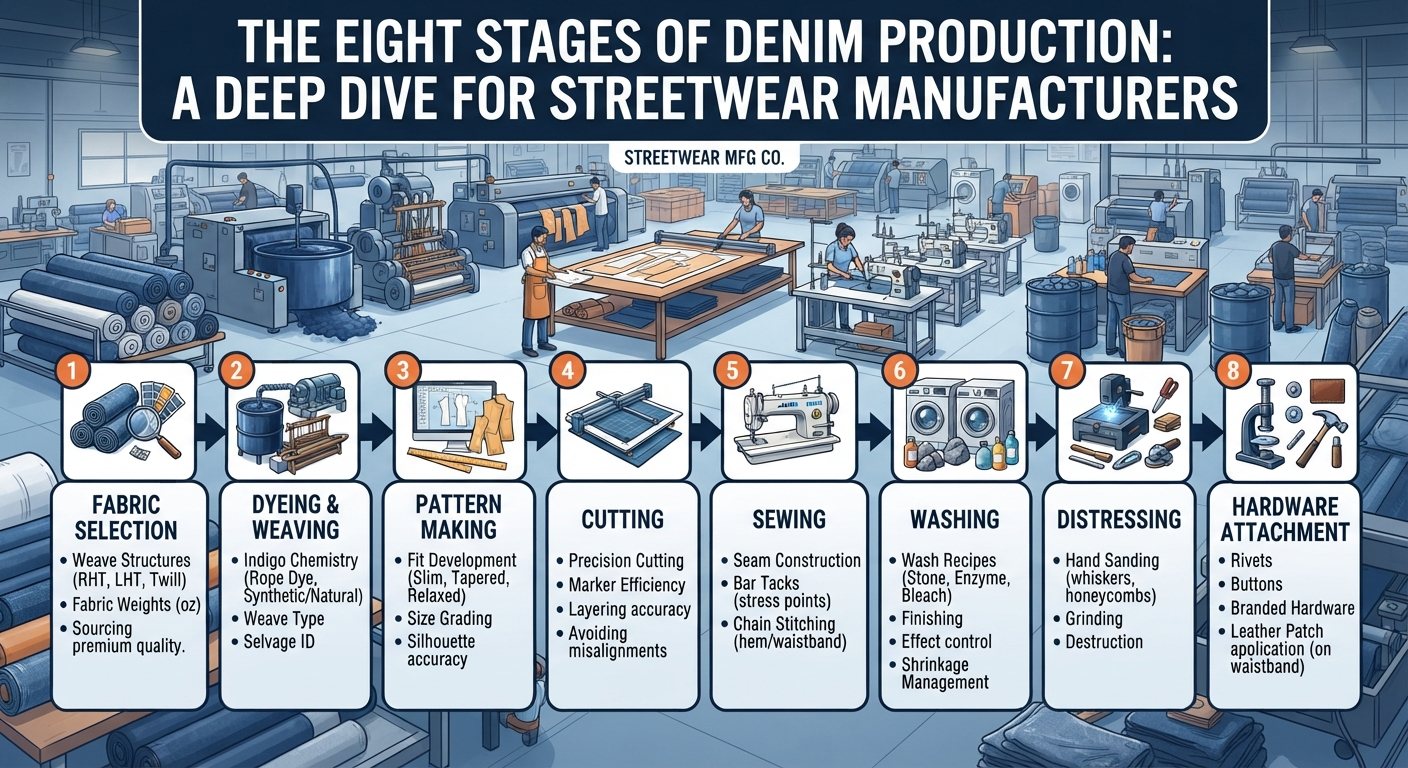
Why Denim Is the Hardest Garment to Manufacture
Step 1: Choose the Right Denim Fabric
Raw Denim
Selvedge Denim
Stretch Denim
Organic & Recycled
Step 2: From Cotton to Cloth — Dyeing and Weaving
Dyeing Method
Color Consistency
Speed
Best For
Rope dyeing
Excellent — even distribution
Slower
Premium indigo and selvedge programs
Slasher / sheet dyeing
Good — risk of side-to-side variation
Faster
High-volume standard blue programs
Sulfur dyeing
Consistent per shade
Medium
Black, grey, and fashion colors
Step 3: Pattern Making and Cutting
Approach
Speed
Accuracy
Waste Control
Digitized pattern + nested marker
1–2 days for a full style
High — repeatable across reorders
Best — automated nesting
Manual pattern and layout
3–5 days
Depends on the pattern cutter
Weaker — human judgment
Step 4: Sewing Construction
Step 5: Wash and Finish — Where the Design Happens
Technique
Effect
Relative Cost
Best Use
Stone wash
Soft, worn-in surface with lighter abrasion areas
Low–medium
Classic vintage looks
Acid wash
Marbled, high-contrast patchwork fading
Medium
Y2K and retro streetwear
Enzyme wash
Removes surface indigo, softens fabric, natural fade
Low
Clean everyday fades
Bleach / spray
Targeted color removal, artistic patterns
Medium–high
Statement and artisanal pieces
Laser finishing
Precise whiskers, honeycombs, and fades with no water
High setup, low per-unit
Repeatable signature fades at scale
Step 6: Distressing — Hand Sanding, Grinding, Ripping, Patching
Step 7: Hardware — Buttons, Rivets, Zippers, Patches
8 Quality Checkpoints Every Denim Order Needs
Denim Production at Vainnx
Denim Manufacturing FAQ
What is the difference between selvedge and regular denim?
Can a factory replicate my existing sample pair of jeans?
What is the minimum order quantity for custom denim?
How long does sampling and bulk production take?
How do I choose the right wash for my collection?