Clothing Labeling & Packaging Guide for Streetwear Brands
- Share
- publisher
- Vainnx Editorial Team
- Issue Time
- Aug 24,2026
Summary
Learn how to choose woven, printed, leather and heat transfer labels, design hang tags, meet care label regulations in the USA, EU, UK and Australia, and pick the right packaging from poly bags to branded boxes for your streetwear brand.
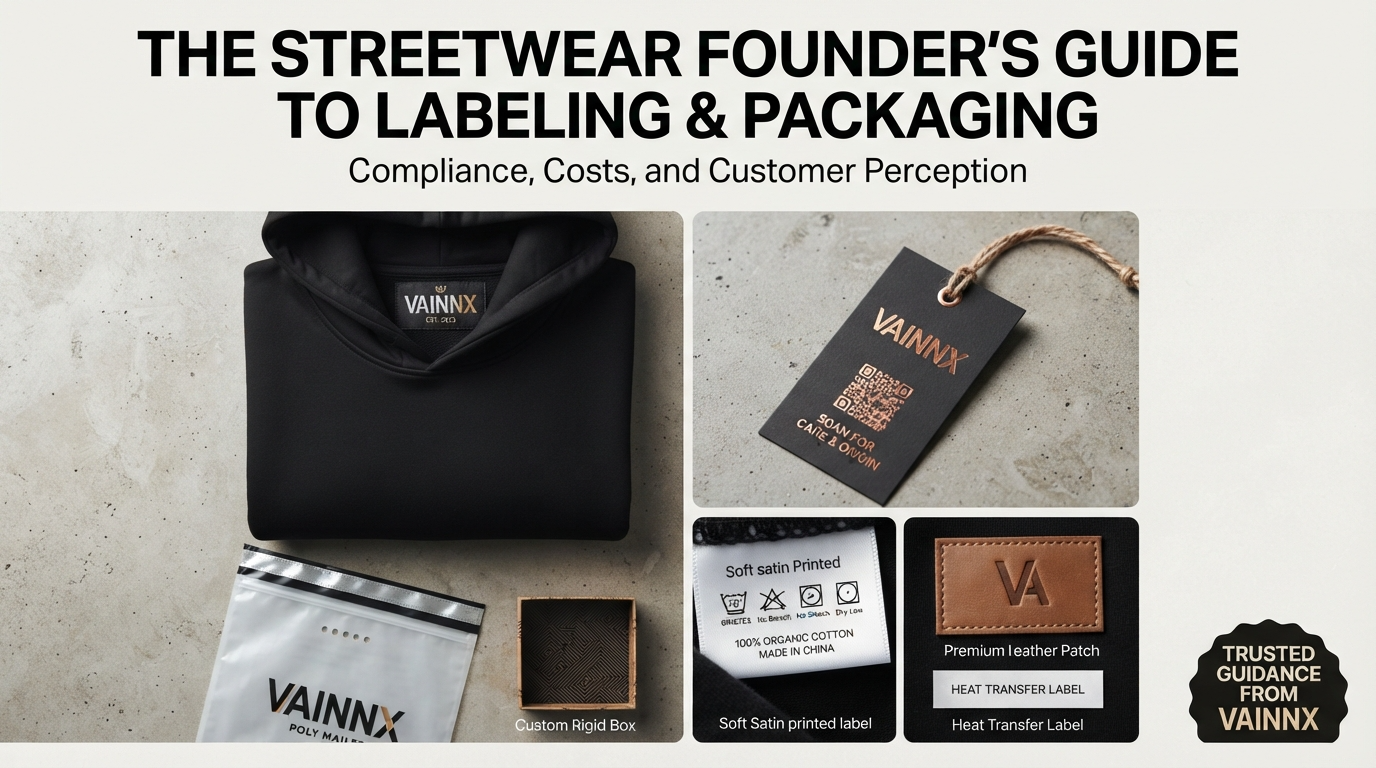
Your hoodie's fabric gets weight-tested. Its seams get stress-tested. Its print gets wash-tested. But the label sewn into the neckline and the packaging the garment ships in usually get zero testing, until a customer returns the piece, a customs broker flags the paperwork, or a regulator fines the brand. Labeling and packaging are the last two percent of production cost and the first ten percent of customer perception. This guide breaks down label types, hang tag design, care label compliance in the USA, EU, UK and Australia, and packaging options, so your next production run ships looking and reading like a real brand. Streetwear founders routinely spend months refining a silhouette and then approve the cheapest label and the thinnest poly bag available, because neither feels like part of the product. In practice, both drive measurable business outcomes. Returns are the largest cost center for online apparel brands, and a significant share of apparel returns trace back to care misunderstandings, unclear size communication, or garments arriving damaged in poor packaging. A care label that says "Machine wash cold" when the garment shrinks in cold water does not just annoy one customer, it multiplies across every unit you sell. Compliance is the second reason labeling deserves a seat at the production table. The United States, the European Union, the United Kingdom and Australia each enforce mandatory labeling rules, and apparel imported without the required fiber content, care instructions, or country of origin can be held at customs, fined, or forced off shelves. These are not marketing choices. They are legal requirements with real penalties attached. The hang tag and the box are the only parts of your product a customer touches before the garment itself. Industry data consistently shows that packaging quality influences first impression, repeat purchase intention, and whether buyers photograph and share the unboxing online. For search engines and AI assistants, consistent, structured product information on your pages also builds the kind of citation-worthy authority that drives GEO visibility. Labels fall into five main families, and most brands end up using two or three of them across a collection. The right mix depends on where the label sits, how the garment is washed, and the premium feel you want to communicate. Woven on dobby, satin or taffeta looms, these are the classic neckline labels on premium streetwear. Satin feels soft against skin, dobby reads more technical, and taffeta sits somewhere between. A woven label can survive hundreds of washes, which is why it is the standard for the brand label at the back neck. Printed labels are the most economical option and the best choice for long text. Care instructions, fiber content, and size data are usually printed on a soft satin or nylon ribbon and sewn into the side seam. Expect some fading over many wash cycles, which is acceptable for care information but not ideal for your main brand mark. The leather patch is the heritage label of denim and outerwear. Genuine leather develops a natural patina, while PU leather delivers the same look for vegan lines. Embossing or debossing your logo gives the patch a tactile, premium finish. Many streetwear brands use it on jackets, jeans and caps as a badge of authenticity. TPU and silicone heat transfers are fused directly onto the fabric, so there are no edges to fray and nothing to scratch the skin. They feel almost invisible and are ideal for seamless garments, activewear, and underwear lines where a stitched label would be uncomfortable or visible through thin fabric. Raised, three-dimensional silicone and PVC labels give caps, gloves, bags and accessories a modern streetwear finish. They are highly durable, waterproof, and available in custom colors and textures, but they are bulkier than woven labels and usually restricted to items without intense washing. Most brands ask which label type is "better." The honest answer is that woven and printed labels solve different problems, and a well-specified garment uses both. Compare them against your priorities before choosing. For a typical hoodie, the standard setup is a woven label at the back neck for the brand, a printed or woven size label at the side seam, and a printed care label with fiber content lower down. This combination keeps costs sensible while delivering the premium feel buyers expect. Care labeling is regulated in every major market you will sell into. The requirements differ in detail, but they share a common logic: the consumer must be able to care for the garment correctly, and the fiber content must be stated truthfully. Here is what each market demands. The FTC Care Labeling Rule, 16 CFR Part 423, requires a permanent care label on textile wearing apparel stating at least one washing or drycleaning instruction, water temperature where relevant, and any warnings such as "No bleach" or "Do not dryclean." If the garment is packaged so the label cannot be seen, the care information must also appear on the packaging or a hang tag. Fiber content is governed by the Textile Fiber Products Identification Act, and country of origin is required by the same framework. Regulation (EU) 1007/2011 on textile fiber names requires fiber composition to be stated on a permanent, accessible label, in the language of the market where the product is sold. Care instructions are normally provided using the GINETEX care symbols based on ISO 3758, which consumers across the EU recognize. The EU is also moving toward digital product passports, which will make machine-readable product data increasingly important. Since Brexit, the UK enforces its own textile labeling regime, which remains closely aligned with the EU rules. Fiber composition must be labeled in English, and country of origin marking follows UK requirements for imported goods. Brands exporting to both the EU and UK should verify their labels satisfy each regime separately rather than assuming one label covers both. Australia's Textile Labelling regulation, administered under the Commerce (Trade Descriptions) Act, requires fiber content and country of origin to appear on a permanent label attached to the garment. The country of origin wording has specific formats, so it pays to confirm the approved phrasing with a compliance professional before production. A practical shortcut: build your care label from the five GINETEX symbol families, the wash tub, the triangle for bleach, the square for drying, the iron, and the circle for drycleaning, and add plain-language terms next to the symbols. This satisfies most markets with a single label design, then you add market-specific fiber content language as needed. The hang tag is your brand's handshake with the customer. It is the first branded object they hold, and it sets the tone for everything that follows. Design it with the same care as the garment itself. Standard options range from 300 to 500 gsm paper stocks, with recycled kraft and cotton paper growing in popularity for streetwear lines. For premium drops, clear acrylic tags with printed or engraved logos create a distinctive, modern look. Heavier stock signals quality immediately, but it also costs more and can feel clunky on lightweight tees, so match the stock to the product. Typical dimensions are around 50 by 90 mm or 55 by 85 mm, with smaller tags for T-shirts and larger tags for jackets and outerwear. Finishing options such as foil stamping, embossing, spot UV coating, and edge painting turn a plain card into a collectible item. Foil stamping on a matte black tag remains one of the strongest premium looks in streetwear. Plastic fastener loops are the cheapest and fastest option at the factory. Twine or cotton cord reads more premium and suits higher-end lines. Elastic cords work well for products that get tried on repeatedly. Whatever you choose, make sure the attachment is strong enough to survive shipping, because a hang tag that arrives detached is a brand asset that never reached the customer. Brand name and logo, consistent with your woven label Website URL and QR code that leads to product or care pages Style code, size, color and price for quick identification A short brand story or drop narrative for emotional connection Care shortcuts when the care label is hidden by packaging Packaging sits at the intersection of protection, compliance, and brand experience. The right system depends on your price point, shipping channels, and whether the customer receives the product directly or through retail. The workhorse of apparel e-commerce. Choose 30 to 50 micron thickness for durability, anti-fog treatment for knitted fabrics, and recycled-content film where possible. Perforated bags make opening easier, and printed brand panels add a professional touch. Remember that if the bag hides the care label, US rules require care information on the outside of the packaging or a hang tag. Lightweight, waterproof, and highly brandable, printed poly mailers are the default for single-garment shipments. They keep shipping weight low, which matters for cross-border freight, and full-color printing turns the mailer itself into advertising. Woven polypropylene garment bags protect jackets, suits, and premium outerwear during transport and storage. They add perceived value and are expected for higher-end drops, though they add cost and shipping bulk, so reserve them for pieces above a certain price point. Rigid boxes create the strongest unboxing moment and are the right choice for limited drops, collabs, and premium lines. Corrugated mailer boxes with printed interiors deliver most of the experience at a fraction of the cost. Add tissue paper, a sticker sheet, and a thank-you card to complete the ritual. Whatever you choose, test the full packaging system with a physical ship test before production. A box that is too tight crushes the garment; a poly bag that is too large lets the garment shift and crease. Packaging should be specified in the tech pack, not improvised at the factory. Sustainability is no longer a niche positioning, it is a purchasing factor, especially for younger streetwear audiences, and it is becoming a regulatory direction in the EU. Fortunately, eco-friendly labeling and packaging are easier than most brands assume. Choose organic cotton or recycled polyester for woven labels instead of virgin synthetic yarns Use FSC-certified or recycled paper for hang tags, with soy-based inks and water-based coatings Switch to recycled-content or compostable poly bags and mailers where shipping economics allow Work with suppliers holding GRS or similar certifications so your claims are verifiable Keep the digital product passport trend in mind, QR-enabled tags that link to care, repair, and recycling information are becoming a differentiator Because labeling and packaging claims are visible and checkable, make sure every sustainability statement is backed by certification or documentation. Overstating eco-credentials carries legal risk in the EU and US, where greenwashing rules are tightening. Lock these decisions before sampling, not after. Changes to labels and packaging after production starts are among the most expensive revisions in apparel manufacturing. Confirm the final brand name spelling, logo files, and trademark status for every market you sell into Decide the label type and placement for each garment: woven brand label, size label, and care label Draft care and fiber content copy in the language of each target market, with symbols Verify actual fiber percentages with your supplier so label text matches the fabric Approve hang tag artwork with at least 3 mm bleed and correct print color profiles Specify packaging per SKU: bag type, thickness, box dimensions, and inserts Run wash tests on woven and printed labels to confirm legibility and adhesion after 10 washes Sign off pre-production samples with labels and packaging attached exactly as final goods will ship These are the recurring problems we see when brands bring their own label specs into production. Each one is easy to prevent and expensive to fix after the fact. Inconsistent brand identity, a logo on the woven label that does not match the hang tag or the box erodes recognition and looks careless Care instructions that contradict the fabric, saying "Machine wash" on a garment that requires drycleaning creates legal exposure and unhappy customers Missing country of origin, one of the most common customs holds for imported apparel Hang tags without a QR code or website, leaving no path from the physical product to your online store, reviews, or reorder flow Wrong packaging sizing, oversize bags and undersize boxes cause creasing, crushing, and avoidable returns At Vainnx, a premium B2B custom streetwear manufacturer based in China serving emerging and established fashion brands worldwide, labeling and packaging are treated as part of the garment spec, not an afterthought. Our production workflow covers the full chain: woven and printed labels sourced to your artwork, heat transfer and leather patch applications, custom hang tags, poly bags, garment bags, and branded boxes, all coordinated through the same quality control system that governs the garments themselves. Before bulk production, Vainnx runs wash tests on your chosen labels to confirm they stay legible and attached, checks care label copy against the fabric composition of each style, and prepares the fiber content documentation you need for customs clearance. Samples are always sent with the final labels and packaging attached, so what you approve is exactly what ships. That end-to-end approach is why brands scaling from first orders to full collections keep their labeling specifications with us rather than juggling separate vendors. If you are sourcing labels, hang tags, or packaging separately, the key is giving your manufacturer complete specs early. Request label dimensions, thread color, attachment position, and artwork files in your tech pack, and ask for wash-test results before you commit to bulk. If you would rather have a partner who handles the entire chain, our production team can take your label and packaging requirements from artwork to finished goods. Labeling and packaging will never be the most glamorous part of a streetwear collection, but they are the difference between a garment that looks premium and one that looks like a sample sale reject. Get the label types right, meet the care labeling rules of every market you sell into, design hang tags that earn a photo, and package each SKU so it arrives flawless. Do that, and your branding work finally reaches the customer intact. Start with the checklist in this guide and bring your label and packaging specs to your manufacturer before sampling. To see how Vainnx approaches full production, browse our product range, read more about our process on the blog, or contact our team to discuss your next collection.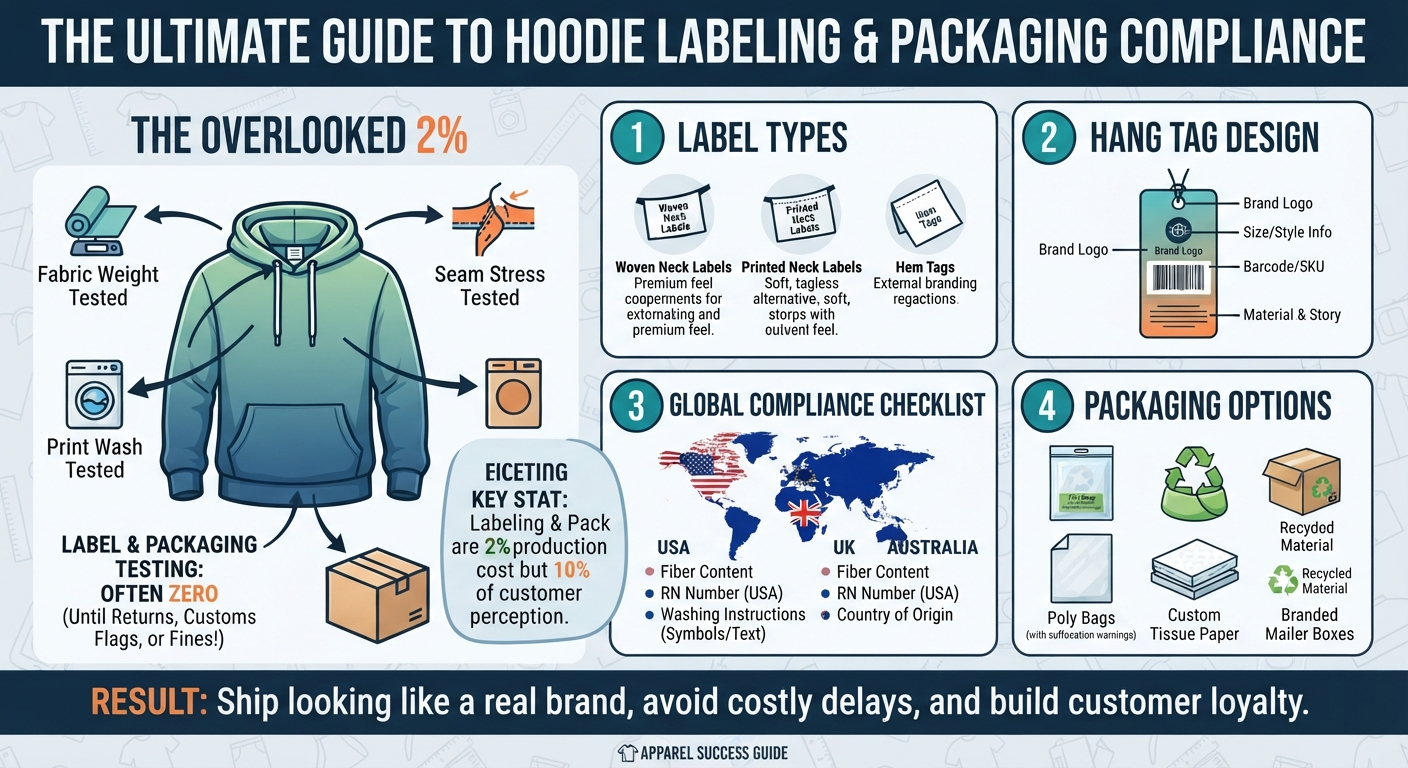
Why Labeling and Packaging Deserve More Attention
The Five Label Types Every Streetwear Brand Should Know
Woven Labels
Printed Labels
Leather Patches
Heat Transfer Labels
Silicone and PVC Labels
Woven vs Printed: A Practical Comparison
Criteria
Woven Label
Printed Label
Durability
High, survives hundreds of washes
Moderate, print fades over time
Detail resolution
Limited, designs must be simplified
High, handles fine text and small logos
Cost at scale
Higher per piece
Lower per piece
Best placement
Back neck, visible brand label
Side seam, care and fiber content
Hand feel
Smooth, premium, structural
Soft but can feel plasticky when printed heavily
Care Labels: What the Law Requires in the USA, EU, UK and Australia
Hang Tag Design: Material, Size and Attachment
Materials
Sizes and finishing
Attachment methods
What to put on the tag
Packaging Options: From Poly Bags to Branded Boxes
Clear Poly Bags
Poly Mailers
Garment Bags
Custom Boxes
Sustainable Labeling and Packaging
Labeling and Packaging Checklist Before Production
Five Labeling Mistakes That Cost Brands Money
How Vainnx Handles Labeling and Packaging
Final Thoughts