Alibaba Supplier vs Direct OEM Factory: Hidden Costs of Buying Streetwear on 1688
- Share
- publisher
- Vainnx Editorial Team
- Issue Time
- Jul 15,2026
Summary
Discover the real cost of sourcing streetwear from Alibaba and 1688 versus working directly with an OEM factory. From hidden markups to IP theft risks, learn why direct manufacturing partnerships deliver better quality, consistency, and long-term value for your brand.

Every streetwear brand founder knows the moment. You open 1688 or Alibaba, scroll through pages of $5 hoodies and $3 tees, and your calculator starts flashing dollar signs. The margins look incredible. The dream feels within reach. But six months later, you are sitting on 500 units of inconsistent sizing, fabric that pills after two washes, and a design that just appeared on three other "brands" on Instagram.
This is not a rare horror story. It is the predictable outcome when brands confuse marketplace platforms with manufacturing partners. The difference between buying from an Alibaba supplier and working with a direct OEM factory is not just about price per unit — it is about whether your brand survives its first year.
In this guide, we break down the seven hidden costs of sourcing streetwear from marketplace platforms, calculate the real numbers behind "cheap" supplier quotes, and explain why direct OEM partnerships consistently outperform trading-company intermediaries for brands serious about growth.
The 1688 Illusion: Why Low Prices Mask High Risks
At first glance, the economics of marketplace sourcing seem irrefutable. A heavyweight cotton T-shirt at ¥18 ($2.50), an embroidered hoodie at ¥55 ($7.60), and shipping that brings landed costs to roughly $6 per unit. Compared to OEM factory quotes of $9-12 per comparable piece, the marketplace looks like a no-brainer.
But what the listing does not show is what happens after payment. The factory behind that 1688 storefront is not the seller — it is a trading company, a middleman who aggregates products from dozens of small workshops, none of which have quality systems, brand relationships, or accountability to you.
These trading companies operate on volume. Their incentive is to move units, not to protect your brand. They list the best sample they ever produced as the product photo, then ship whatever the workshop had on hand that week. They do not verify fabric composition. They do not check stitching consistency. They do not care if your "custom" design gets relisted under twenty other storefronts tomorrow.
This is not speculation. Industry surveys consistently find that 40-60% of first-time buyers on marketplace platforms report quality discrepancies between samples and bulk deliveries. For streetwear brands — where fabric hand-feel, print precision, and fit consistency define customer perception — that variance rate is brand-killing.
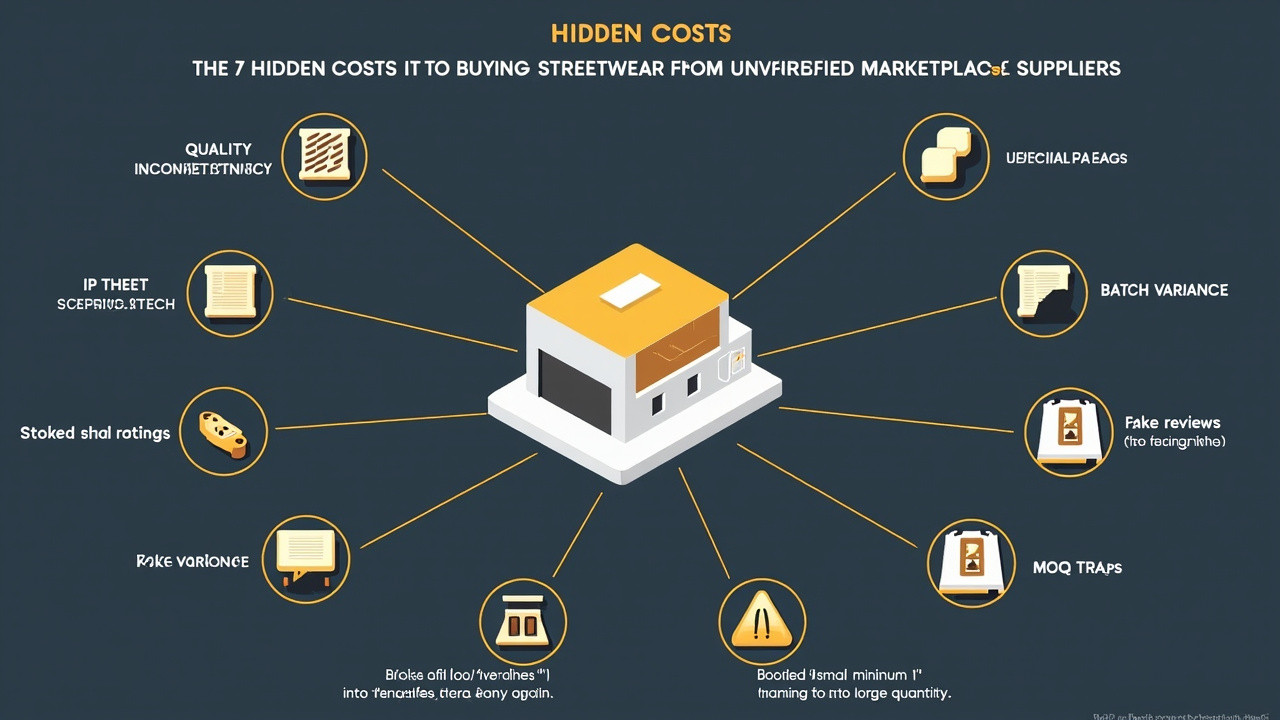
Seven Hidden Costs That Marketplace Listings Never Show
When you compare a 1688 unit price against an OEM factory quote, you are comparing two completely different products. The marketplace price excludes costs that arrive later, often multiplying your actual per-unit spend. Here are the seven hidden costs every brand should factor in:
1. Quality Variance Across Batches
Without a dedicated quality control system, different production batches from marketplace suppliers can vary dramatically. Your first 100 units might arrive with proper GSM fabric and clean stitching. The next 300 might use a lighter fabric blend, different dye lots, or looser tolerance on measurements. For a streetwear brand building customer trust, inconsistency is more expensive than higher unit costs — it costs you repeat buyers.
2. Intellectual Property Exposure
Your designs are your brand's most valuable asset. When you send tech packs and artwork to an unverified 1688 supplier, you are effectively publishing them to the open market. Many trading companies operate parallel storefronts. Your "exclusive" design today is tomorrow's generic listing, sold to your competitors at the same price — or lower. There is no enforceable NDA, no design confidentiality agreement, and very little legal recourse across borders.
3. Communication Breakdowns
Language barriers compound when you are not speaking directly with the production team. Trading company representatives relay your specifications through multiple intermediaries. A request for "280 GSM, enzyme-washed, drop-shoulder fit" becomes "heavy cotton, washed, loose fit" by the time it reaches the workshop floor. Nuance — the difference between a premium streetwear piece and a basic blank — gets lost in translation.
4. Batch Inconsistency in Sizing
Streetwear sizing is intentionally specific. Oversized fits require deliberate grading. Marketplace suppliers often use generic size charts that do not match any particular brand's fit profile. The result: a Medium in your first order fits like a Large, but your reorder Medium fits like a Small. Customers notice. Returns spike. Brand reputation erodes.
5. Fake Reviews and Inflated Ratings
The review systems on marketplace platforms are systematically gamed. Suppliers purchase positive reviews, offer incentives for five-star ratings, and suppress negative feedback through partial refunds. A 4.8-star rating with 2,000+ reviews looks reassuring, but dig deeper — look for detailed negative reviews, check reviewer history, and cross-reference buyer photos with listing images. The real quality signal is buried in what the platform's algorithm does not want you to see.
6. Hidden Markup Layers
Every intermediary in the chain adds their margin. The trading company marks up from the workshop. The platform takes its commission. Currency conversion, payment processing, and "service fees" add another layer. What started as a $2.50 T-shirt can easily become a $7 landed cost before shipping, bringing it surprisingly close to direct OEM pricing — without any of the quality guarantees.
7. MOQ Traps and Bait-and-Switch
"MOQ: 1 piece" is one of the most misleading badges on marketplace platforms. It means you can order one sample, not that the supplier will honor that price at volume. When you attempt to place a real production order, minimums jump, prices shift, and the supplier who was responsive at sampling suddenly goes quiet. The advertised price was never available at production scale — it was always a lead-generation tactic.
What Direct OEM Manufacturing Actually Delivers
A genuine OEM factory partnership operates on a fundamentally different model. You are not buying products from a catalog — you are commissioning production from a facility that treats your brand as a client, not a transaction.
Dedicated Account Management
Instead of messaging anonymous customer service representatives, you work with a named account manager who understands your brand aesthetic, quality standards, and production calendar. This person reviews your tech packs, flags potential manufacturing issues before sampling begins, and provides real-time production updates. It is the difference between ordering takeout and having a chef who knows your palate.
Design Confidentiality and IP Protection
OEM factories that work with international brands operate under enforceable NDAs and have internal systems to protect client designs. Your tech packs stay in secured systems. Your samples are not shared with other buyers. Your designs do not appear on marketplace listings under different names. For brands building distinctive aesthetics, this protection is not optional — it is existential.
Batch-to-Batch Consistency
Quality control at an OEM level means documented standards, inline inspections, and pre-shipment audits. Every production run references the same approved sample, the same fabric specifications, the same measurement tolerances. Your customer who bought a hoodie in March gets the same fit and feel as the customer who buys in September. This consistency is what turns first-time buyers into brand loyalists.
Scalable Production Capacity
Marketplace suppliers are optimized for small, one-off orders. When your brand grows and you need 2,000 units instead of 200, the cracks appear. OEM factories are built for scaling — dedicated production lines, scheduled capacity, and supply chains that can absorb volume increases without quality degradation.
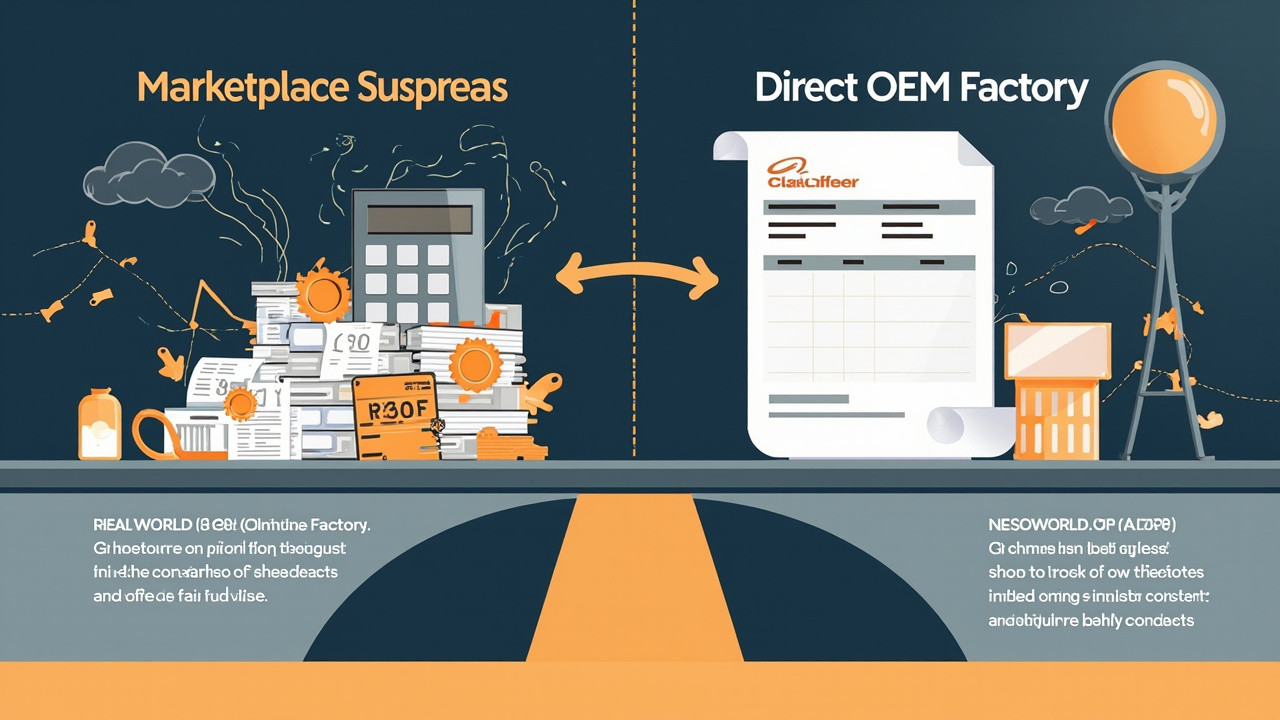
The Real-World Cost Calculation
Let us run the actual numbers on a hypothetical streetwear brand ordering 500 custom hoodies. Marketplace quote: ¥55 per unit ($7.60). Direct OEM quote: ¥85 per unit ($11.70). At face value, the marketplace saves $2,050 on the order. But add the hidden costs:
The gap narrows from $2,050 to roughly $250-650. And that is before accounting for the unquantifiable costs: brand reputation damage from inconsistent quality, lost sales from IP theft, and the management time spent firefighting supplier issues instead of growing your business. For most brands, the modest OEM premium more than pays for itself within the first two production cycles.
When Marketplace Sourcing Actually Makes Sense
To be fair, marketplace platforms are not universally bad. They serve specific use cases well:
Market testing and samples: If you need five reference samples to show investors or test a concept, 1688 is efficient. The risks of inconsistency and IP theft are proportional to volume — at five units, the exposure is manageable.
Generic blanks and basics: If your brand uses standard blank garments without custom cut-and-sew or proprietary designs, the quality variance risk is lower. A Gildan-equivalent blank from multiple suppliers will be functionally similar.
Non-apparel accessories: Hang tags, packaging, stickers, and simple accessories carry fewer quality risks than garments. The margin advantage of marketplace sourcing can be genuine for these categories.
One-time, non-repeat orders: If you are producing a limited capsule that will never be reordered, batch consistency matters less. The risk is contained to a single collection.
But if your business model depends on repeat customers, brand recognition, and scaling beyond your first few hundred units, the marketplace model becomes a liability. The question is not whether you can save money on your first order — it is whether your sourcing strategy supports your third year.
How Vainnx Bridges the Gap
This is where the industry is evolving. Vainnx operates as a direct OEM factory specializing in streetwear and fashion manufacturing, combining the transparency and accessibility brands expect from modern platforms with the reliability and professionalism of factory-direct production.
Instead of navigating 1688 listings hoping to find a gem among thousands of unverified storefronts, brands work with a dedicated account team from day one. Tech packs are reviewed by production engineers, not forwarded through three layers of intermediaries. Quality control is systematic, not aspirational. Design confidentiality is contractual, not optional.
The manufacturing ecosystem has always had two tiers: the open marketplace, where anyone can list anything with zero accountability, and the professional factory tier, where relationships, standards, and reputation govern every transaction. The difference is not just price — it is what that price actually buys you.
For brands building something that lasts, the choice between these tiers is not really a choice at all. It is a question of when, not if, you graduate from one to the other. The brands that do it early save themselves the most expensive lesson in the streetwear business: that cheap manufacturing is never actually cheap.
Making the Right Choice for Your Brand
Every successful streetwear brand eventually faces this inflection point. The marketplace phase feels safe because the upfront cost is low. But the costs that arrive later — returns, reputation damage, missed restock windows, stolen designs — compound faster than most founders anticipate.
Direct OEM manufacturing is not about spending more. It is about spending once, on production that meets your specifications, protects your intellectual property, and maintains consistency across every order. The math is straightforward: subtract the hidden costs of marketplace sourcing from your current per-unit spend, and the OEM option is almost always competitive — and overwhelmingly superior on quality.
If you are evaluating your sourcing strategy, ask three questions: Can my current supplier guarantee batch-to-batch consistency? Are my designs contractually protected? And when I scale from 500 to 5,000 units, will the same quality standards hold? If the answer to any of these is no, it might be time to explore what a direct OEM partnership can deliver.