Alibaba Supplier vs Direct OEM Factory: Hidden Costs of Buying Streetwear on 1688
- Share
- publisher
- Vainnx Editorial Team
- Issue Time
- Jul 15,2026
Summary
Discover the 7 hidden costs of buying streetwear from 1688 and Alibaba suppliers. Real cost comparison between platform trading companies and direct OEM factories, plus how Vainnx delivers factory-direct quality with platform-level convenience.
Alibaba Supplier vs Direct OEM Factory: Hidden Costs of Buying Streetwear on 1688
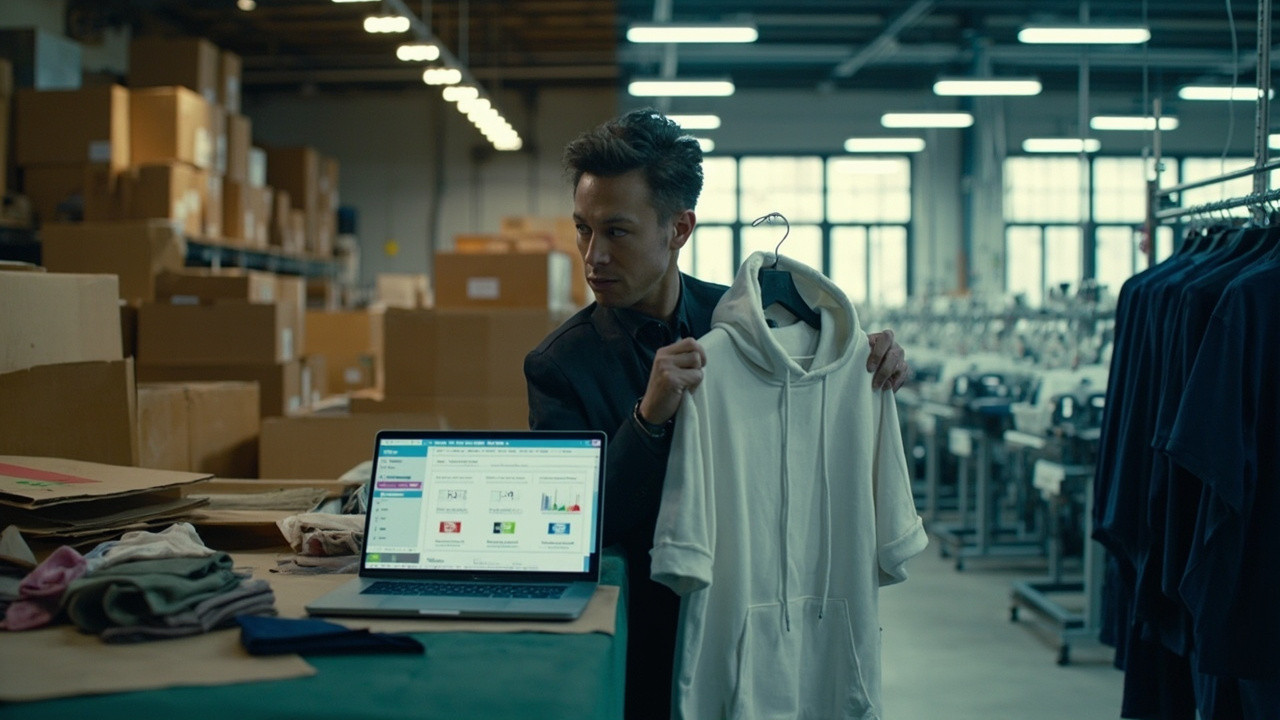
The low prices on 1688 and Alibaba are tempting. But what you do not see — the hidden costs, quality traps, and IP risks — can destroy your brand before it launches. Here is the complete comparison every streetwear entrepreneur needs before placing their first order.
The 1688 Illusion: Why Those Low Prices Are Not What They Seem
Every streetwear entrepreneur starts the same way. You have a vision for your brand — six pieces, maybe eight. You open 1688.com or Alibaba, type "custom hoodie manufacturer," and your eyes go wide. $4.50 for a heavyweight cotton hoodie. $2.80 for a printed T-shirt. The math seems simple: 100 units at $4.50 equals $450. Add $200 for shipping. You are looking at $6.50 landed cost per hoodie that you can sell for $65.
That spreadsheet looks incredible until you receive your first shipment.
The reality of platform-based sourcing is far more complex — and far more expensive — than the listing price suggests. According to industry data from cross-border trade analysts, brands that source exclusively through 1688 or Alibaba trading companies experience a 23-38% effective cost increase once all hidden factors are accounted for. That $4.50 hoodie is actually costing you closer to $7.80 by the time everything settles. And that is before we discuss quality.
At Vainnx, we have spoken with hundreds of brand owners who learned these lessons the hard way. The pattern is remarkably consistent: the initial order looks affordable, the first sample seems acceptable, and then production batch number three arrives looking nothing like production batch number one. By then, you have already promised consistency to your customers.
The 7 Hidden Costs of Buying Streetwear on 1688 and Alibaba
Platform suppliers are not necessarily dishonest. Many are skilled at what they do. The issue is structural — the platform model itself creates incentives that work against your brand's interests. Here are the seven hidden costs that most first-time buyers discover too late.
1. Quality Variance: The Batch-to-Batch Nightmare
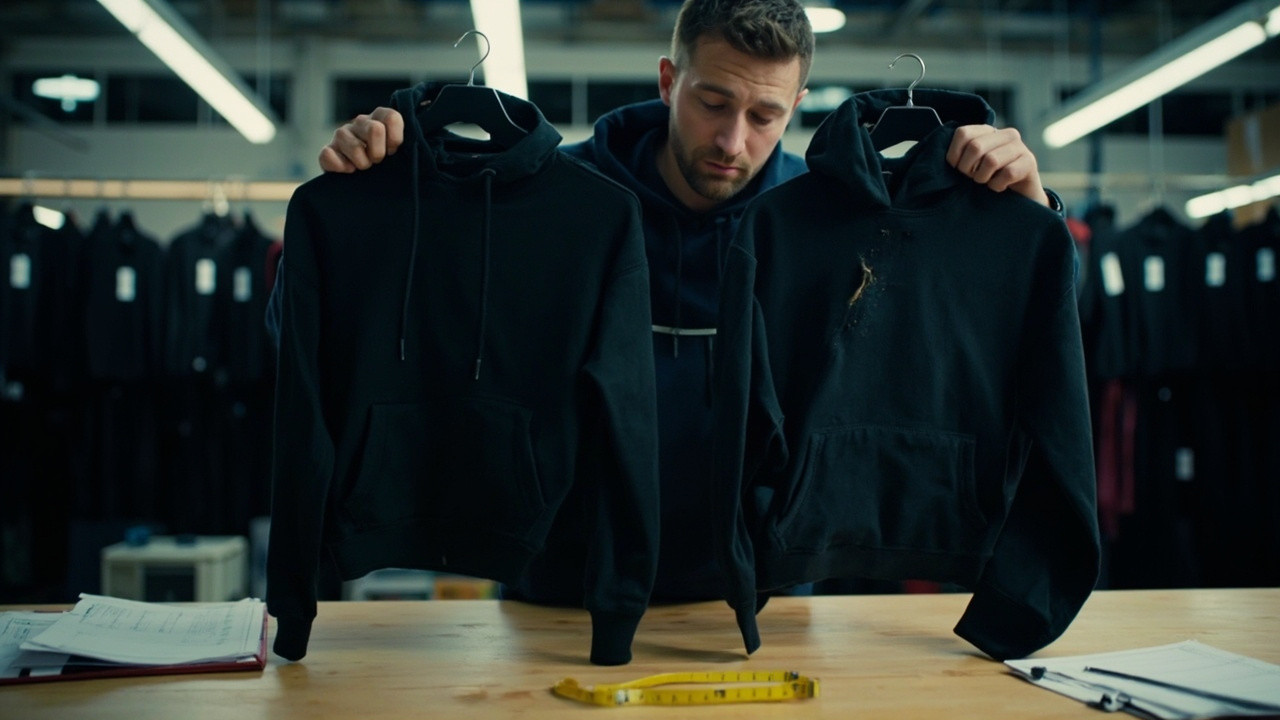
This is the most expensive hidden cost and the most common. Platform suppliers often act as trading companies — they do not own the factory, they simply aggregate orders and forward them to whichever workshop has capacity that week. Your first batch might come from Factory A, your reorder from Factory B. Same SKU, completely different garment.
One brand owner we work with at Vainnx shared a painful example. Their first run of 200 heavyweight T-shirts from a 1688 supplier was beautiful — 320gsm cotton, clean seams, perfect fit. The reorder of 300 units came in at roughly 260gsm with visibly different stitching quality. Different factory, same listing, same price. They had already sold 150 units to customers expecting the first quality level. The refunds and reputation damage cost them over $4,000 — roughly triple what they "saved" by choosing the platform supplier over a direct OEM partner.
Direct OEM factories like Vainnx maintain dedicated production lines. When you reorder, the same team produces your garments using the same machinery, same fabric sources, and your approved gold sample as reference. Batch-to-batch consistency is not a hope — it is a documented process with AQL inspection standards at every stage.
2. Intellectual Property Theft: Your Design Is Not Safe
On 1688, your custom tech pack is just another file in a chat window. Trading companies routinely share successful designs with other buyers — sometimes within days of your order. A streetwear brand we consulted had their entire debut collection appear on three different 1688 storefronts within two weeks of placing their sample order. The designs were modified slightly — different logo placement, slightly different colorways — but unmistakably derived from their original work.
Enforcing IP rights across international platforms is extraordinarily difficult. Most brands lack the legal resources, and by the time action could be taken, the copies have already saturated the market. A direct OEM partnership changes this equation. At Vainnx, every client relationship begins with an NDA. Your designs, tech packs, and specifications remain confidential. We produce for your brand and your brand only. No design sharing, no unauthorized samples, no look-alike production for other clients.
3. Communication Fragmentation: The Rotating Chat Representative Problem
Message a 1688 supplier on Monday, and "Luna" responds within minutes. Message again on Wednesday with a technical question about seam reinforcement, and "David" replies — he has not read the previous conversation and asks you to re-explain everything. By Friday, a third representative picks up the thread and suggests a completely different solution than the one you agreed upon on Tuesday.
This is not an exaggeration. Platform trading companies frequently employ large teams of rotating chat representatives whose primary metric is response time, not resolution quality. Complex manufacturing questions — fabric composition tolerances, wash testing results, embroidery digitization specifications — require consistent communication with someone who actually understands garment production.
Direct OEM factories assign dedicated account managers who know your brand, your specifications, and your production history. At Vainnx, every client works with a single point of contact who speaks fluent English, understands garment engineering, and can give you direct answers without consulting a chat script.
4. Batch Inconsistency in Materials and Sizing
Even when the same factory produces two batches, platform suppliers frequently substitute materials without notice. Cotton sourced from one mill in March might come from a different mill in June. Dye lots shift. Fabric weight drifts. A "320gsm French terry" becomes 290gsm because that is what was available and the trading company assumed you would not notice.
Sizing is another vulnerability. Without a locked and approved size chart maintained by a dedicated manufacturer, grade rules can shift between production runs. That oversized boxy fit your customers loved on the first drop becomes a standard relaxed fit on the second. Returns spike. Trust erodes.
Vainnx maintains approved gold samples for every client SKU. Before any production run, materials are verified against the original specification. Size charts are digitized and locked. Every batch undergoes AQL 2.5 inspection before shipping. When you reorder, you receive the same garment — not a close approximation.
5. Fake Reviews and Inflated Credentials
Platform reviews on 1688 and Alibaba are systematically gamed. Suppliers purchase reviews, offer discounts for five-star ratings, and sometimes create entirely fictional transaction histories. The "Verified Supplier" badge and "10 Years on Alibaba" label provide a surface-level reassurance that does not survive deeper scrutiny.
A Vainnx team member recently conducted an audit of 20 highly-rated streetwear suppliers on 1688. Seven claimed to own factories but were actually trading companies operating from offices with zero production equipment. Three used stolen portfolio images from legitimate manufacturers. One listed BSCI certification that had expired two years earlier. Only four could provide verifiable factory addresses and current compliance documentation.
This is not a minor inconvenience. Choosing the wrong supplier based on fabricated credentials can set your brand back six months or more — time you cannot recover in a trend-driven market. Direct OEM factories invite factory visits, video tours, and independent audits because they have nothing to hide.
6. The Middleman Markup: You Are Paying for Someone Else's Margin
Trading companies on 1688 and Alibaba typically add 15-30% markup to the factory price. This is their business model — they find factories, negotiate prices, and resell to international buyers. The markup itself is not inherently unfair; the issue is that you are paying it without receiving corresponding value.
What does that 15-30% actually buy you? In most cases: a chat representative, some basic English translation, and order forwarding. No quality control. No design confidentiality. No material traceability. No production oversight. The trading company's financial incentive is to minimize factory cost and maximize their spread — not to maximize your product quality.
Direct OEM pricing eliminates this layer entirely. When you work with Vainnx, you pay the factory price — because you are working directly with the factory. The same $4.50 hoodie that a trading company quotes at $6.00 costs you $4.50. Multiply that across a 500-unit order, and the difference is $750 — real money that can fund your next marketing campaign or cover sampling costs for a new design.
7. MOQ Traps: The Minimum Order Deception
Platform listings frequently advertise attractive MOQs — "MOQ: 30 pieces" — to capture inquiries. When you actually attempt to place an order at that quantity, conditions emerge. The price is only valid at 500+ units. The fabric you want requires 200 meters minimum from the mill, so your 30-piece order becomes 200 pieces. Embroidery setup fees add $80. Screen printing screens add $45 per color. The "30 piece MOQ" was a marketing number, not a production reality.
Worse, when you are forced into higher quantities you did not plan for, you are sitting on inventory risk. A 200-piece order that you planned as a 50-piece test run is now a cash flow problem. Direct OEM partners like Vainnx are transparent about MOQ from the first conversation. Our standard MOQ of 50 pieces per style is real — not a marketing hook. We also offer 30-piece trial runs for new brand partnerships because we understand that testing the market before scaling is smart business.

Direct OEM Factory: What You Actually Get When You Cut Out the Middleman
Moving from a platform trading company to a direct OEM factory is not just about cost savings. It is a fundamentally different relationship model — one built on partnership rather than transaction. Here is what changes.
Dedicated Account Management
Your Vainnx account manager knows your brand story, your target customer, your quality standards, and your growth plans. They do not rotate shifts. They do not need you to re-explain your specifications. When you email with a new design concept, they already understand the context. This continuity saves dozens of hours of re-communication per collection cycle and eliminates the "telephone game" problem that plagues platform-based sourcing.
Design Confidentiality and IP Protection
Every client partnership at Vainnx is governed by a formal NDA. Your designs are stored in secure, access-controlled digital systems. Physical samples are labeled and stored separately by brand. No client ever sees another client's work. Your collection is yours — period. This is not a premium feature; it is the baseline standard for professional manufacturing.
End-to-End Quality Control
Direct OEM means we control the entire production chain — fabric sourcing, cutting, sewing, embellishment, washing, finishing, and packing. Quality checkpoints exist at every stage, not just a final once-over before shipping. Our AQL 2.5 inspection standard means that for every 200 garments produced, we pull and inspect 20 samples across defined quality criteria. Defects are caught and corrected before they reach your customers. Platform suppliers — who never touch the product — cannot offer this level of oversight.

Real-World Cost Calculation: Platform vs Direct OEM
Let us put numbers to these concepts. Consider a hypothetical streetwear brand ordering 200 heavyweight hoodies with embroidery.
| Cost Factor | 1688 Trading Company | Vainnx Direct OEM |
|---|---|---|
| Unit Price (200 pcs) | $9.80 | $7.50 |
| Embroidery Setup | $85 | $0 (included) |
| Sampling (3 rounds) | $180 ($60 each) | $120 ($40 each) |
| Shipping (air freight) | $420 | $380 |
| Communication Overhead (20 hrs at $25/hr) | $500 | $200 |
| Quality Failure Reserve (est. 5-10% vs 1-2%) | $196 (10% buffer) | $30 (2% buffer) |
| Total Landed Cost | $3,341 | $2,230 |
| Effective Cost Per Unit | $16.71 | $11.15 |
The platform-sourced order costs 50% more in total and 50% more per unit — not because the factory price was higher, but because the structural inefficiencies of the platform model add up dramatically. Across a full collection of six styles at 200 units each, that is a $6,666 difference. Enough to fund an entire new product line, a professional photo shoot, or a targeted ad campaign.
When Platform Sourcing Actually Makes Sense
Fairness demands we acknowledge that 1688 and Alibaba are not always the wrong choice. There are specific scenarios where platform sourcing is a rational decision:
Market research phase: If you are ordering 5-10 sample pieces across multiple suppliers purely to evaluate fabric quality, construction methods, and general capabilities before committing to a production partner, platform sourcing can be cost-effective. The risk is minimal because you are not putting your brand reputation on the line.
Commodity basics: Plain blank T-shirts, basic tote bags, and unbranded accessories with no customization beyond a simple logo print are low-risk categories where the differentiation between suppliers is narrower. Even here, quality consistency remains a concern.
Non-design-critical items: Packaging supplies, generic hang tags, poly bags, and care labels rarely justify dedicated OEM relationships. Platform sourcing for these ancillary items is practical.
The line is clear: the moment your product involves custom design, specific fabric requirements, specialized techniques like embroidery or rhinestone application, or your brand reputation is attached — direct OEM is the only rational choice.
How Vainnx Bridges the Gap Between Platform Convenience and Factory Quality
The honest reason many brands stay on 1688 despite knowing the risks is that finding and vetting a direct OEM factory feels overwhelming. The platform offers discovery and transaction infrastructure that standalone factories historically did not. Vainnx has invested heavily in changing that equation.
Our communication infrastructure matches platform convenience. We respond within hours, communicate in fluent English, provide photo and video updates from the production floor, and maintain transparent timelines. You get the accessibility of a platform chat experience with the depth of a dedicated manufacturing partner.
Our sampling process is structured to reduce risk. First samples are produced within 7-10 business days with detailed photo documentation. Fit samples follow with precise measurement verification. Gold samples — the final approved reference — are stored both physically and digitally for every SKU. You never wonder what standard your production is being measured against.
Our quality infrastructure is independently verifiable. Factory certifications, material traceability documentation, and batch-level QC reports are available to every client. We welcome factory visits and video tours because transparency builds the trust that platform reviews can only simulate.
Vainnx does not ask you to choose between low prices and reliable quality. The direct OEM model — when executed properly — delivers both. The $7.50 hoodie from Vainnx is not competing with the $4.50 platform listing that becomes $16.71 after hidden costs. It is competing with the expectation your customers have when they spend $65 on your brand.
The Decision Framework: 5 Questions Before You Choose
Before placing your next manufacturing order, answer these five questions honestly:
- Is your design unique enough to be worth copying? If yes, you need IP protection that only an NDA-backed OEM partnership provides.
- Would a 10% quality variance damage your brand? If your customers expect consistency, batch-to-batch quality control is non-negotiable.
- Do you plan to reorder the same styles? If this is not a one-time purchase, continuity of production matters enormously.
- Is your per-unit margin less than $20? If so, the hidden costs of platform sourcing may consume your entire profit.
- Can you afford a 6-month delay from a failed supplier relationship? In streetwear, missing a season can mean missing the trend entirely.
If you answered yes to any of these questions, direct OEM is your path. The short-term convenience of platform sourcing is not worth the long-term cost to your brand.
Conclusion: The Real Price of Cutting Corners
The streetwear market in 2026 is more competitive than ever. Brands are not just competing on design — they are competing on consistency, quality perception, and customer trust. A single batch of poorly made garments can erase months of brand building. The $750 you save on a platform order means nothing if it costs you $5,000 in returns, refunds, and reputation repair.
Vainnx exists because we believe emerging streetwear brands deserve the same manufacturing quality and partnership experience that established labels receive. Direct OEM is not a luxury reserved for brands doing 10,000 units a month. It is a competitive necessity for any brand that takes its product seriously.
Ready to experience the difference between a transaction and a partnership? Contact Vainnx today for a transparent quote on your next collection. No hidden costs. No rotating chat representatives. Just honest manufacturing from a factory that treats your brand like our own.